
Stories of digital innovation by no-code
Discover the opportunities of the channel program
Join the Network
Leverage the resources of Jamio
We collaborate with universities
News from the world of Jamio Openwork
Stay up to date on the world of no-code and digitalization
The periodical on no-code and BPM
Events dedicated to Jamio producers, partners, and customers
Free downloadable guides
Independent Software Vendor
Join our team
Our locations
Forever part of who we are
Jamio has tools to model a generic business entity to represent any real-world object, for example a product sheet , a quote sheet , a support request , a customer profile , etc.
The card is intended to collect a set of information and documents that can be entered by a person directly or during the execution of a process, or by an external system , or automatically pre-populated based on contextual and/or conditional information (e.g., date, author, author role, etc.).
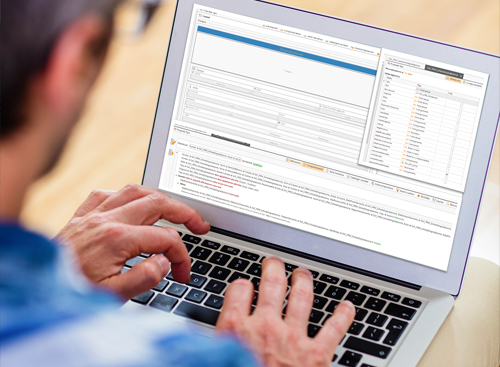
To model an information sheet ( form ) with Jamio Composer , we start from a basic model and enrich it with additional fields for collecting metadata : all those necessary to manage our business case in the most appropriate way (texts, dates, images, files, lists, links to other objects, etc.). In design time , the designer, in addition to being able to represent the information to be managed, can also define the way in which the user must interact with it ( layout ) and the behavior of each field by setting business rules that can be assertive, assignment or validation (e.g.: the "author" field is disabled, the "amount" field is visible only to the head of the person who inserted it", the "date" field must contain a value equal to today plus 10 days.........). Furthermore, for each card the life cycle Access Control Lists are assignable . These, together with many other Data Management , make it possible to manage a multiplicity of business cases always using a no-code Human Resource Oriented
Once the solution is published to a Jamio workspace with one click form modeled in design time is immediately usable from the front end . The different forms compiled from the same template, based on an authorization profile , can be navigated and explored through catalogs, which are lists of forms of the same type, possibly filtered according to a selection rule.