












Stories of digital innovation by no-code
Discover the opportunities of the channel program
Join the Network
Leverage the resources of Jamio
We collaborate with universities
News from the world of Jamio Openwork
Stay up to date on the world of no-code and digitalization
The periodical on no-code and BPM
Events dedicated to Jamio producers, partners, and customers
Free downloadable guides
Independent Software Vendor
Join our team
Our locations
Forever part of who we are
The Jamio 4.8R4 introduces many improvements mainly designed to simplify the work of designers , with clearer and more efficient tools for modeling.
The main new feature concerns the definition of Human Task participants during the process modeling phase, which can now be defined through lists , which makes process design simpler and execution more efficient.
Alongside this, the release brings enhancements to Jamio Composer, Job Engine, Jamio Plug and OEL library security and compliance measures .
Until the previous version, the participants (Executors, Observers, Administrators) in a Human Task were defined through filters , i.e. abstract business rules that determined who should receive the task.
With the 4.8R4 release , assignment becomes clearer and more powerful: participants are now defined via reference lists – explicit lists of users, roles, groups or organizational units – that can be derived from configuration parameters , process and activity , as well as inputs and outputs .
The change brings benefits on two fronts:
– at design time , with greater control for designers to identify, verify and update participants consistently and unambiguously;
– at run time , with more efficient processes and optimized performance.
New services that operate on participants have also been added
Value for business:
, Human Tasks become clearer, faster and more easily trackable , with a direct impact on efficiency, reliability and productivity.
The platform is enriched with additional measures and guidelines designed to strengthen compliance with GDPR and guide organizations towards even more secure and transparent :
creation of accounts associated with the Automation has been prevented , thus consolidating the security practices already in place;
– from now on it is recommended to use the Super Administrators to insert the users who must have these privileges in addition to the Administrator , for clearer and more traceable management of the same;
Jamio 4.8R4 further raises the bar on security and compliance , translating regulatory obligations into concrete governance , reliability and trust benefits for the business .
Two new features have been introduced for the Electronic Signature services of the Document Automation Plugin :
– It is now possible to add an advanced electronic signature visible to PDF files, customizable in the settings, and secure with OTP authentication. This feature increases transparency, trust, and simplicity in managing digital documents;
advanced electronic signature processes relating to a natural person , using the Electronic Seal .
Alongside this new feature, there are also:
– two new controls – Ranking and Dynamic Panel – in Survey Designer , to sort a list of n points and manage a grid of values with multiple rows;
– support for data containing list-type fields in Elastic Storage .
The new features introduced transform document and data management into a more secure , transparent and powerful , with direct impacts on trust, compliance and the quality of business decisions.
The OEL library is enriched with new functions for dates, text, lists and many more.
Value for business:
The expansion of the OEL library makes Jamio even more flexible and powerful , with benefits that translate into faster processes, more reliable data and less reliance on complex technical interventions .
Improvements have been made to attachment handling by normalizing checks on the filename parameter in attachment methods, and the FTP , Jamio Document , and Mail by adding new methods and parameters.
New attachment and connector enhancements make Jamio more secure, reliable , and efficient , improving document management and integrations with the corporate ecosystem.
The Job Catalog, available in the Admin Console, now displays new information columns such as the number of total resources to be processed and the number of resources processed, improving clarity.
The Admin Console, thanks to a clearer view of the status of job processing, useful for governance and control, becomes more readable and useful , reducing complexity and increasing Jamio's digital processes
Jamio composer is enriched with new features to support the designer, among the main ones:
– the Duplicate action is also available for filters in related catalogs and catalog restrictions;
– introduced drag&drop for defining the columns of a DataGridView ;
– new management methods for updatable fields of the Link and Extended Link type, with the possibility of deciding whether to manage only the update, or also the deletion or cascade deletion, in case of modification of the Name of the pointed resource or its deletion.
Jamio Composer's new utilities increase designers' productivity , with a positive impact on business: more speed, more quality, more control and satisfied end users .
This release introduces greater consistency in document publishing .
The new modality requires attention as the behavior has changed to make it consistent with the expectation.
“No changes” option is selected version number parameter, this means that a new version of the document is not issued but that publishing simply implies overwriting the version you were working on .
Increment number (of the minor and major version are selected, the publication implies that the version from which we started is frozen and historicized with the version number it had and a new version with the new number incremented in the minor or major part depending on the option chosen.
The new features introduced make document versioning clearer, more flexible and streamlined , ensuring operational efficiency and regulatory robustness.
News on some platform catalogs:
– Assignments is renamed to Tasks
– In Documents in progress and Document administration, File column has been added , which provides a link to the file containing the document.
– Additionally, you can now preview JSON files as well
The new features of Jamio on Stage improve clarity, transparency and usability , making the platform even more aligned with business needs and even more efficient in the day-to-day management of data and documents.
The release also includes a number of fixes on several components:
• Jamio Admin Console and ES Browser
• Jamio Composer
• Jamio On Stage
• Jamio Human Task
• Jamio Resource
• Jamio Document
• Jamio Plug Elastic Storage, Survey, Message
• Job Engine
• OpenAPI
The new version of Jamio openwork 4.8.4 changes the way designers Human Task participants Jamio Composer . This applies to the definition of Potential Owners, Business Administrators, and Observers (Stakeholders).
Until the previous version, participants were set through filters , i.e. abstract business rules, which determined who should receive an activity.
reference lists are defined in the participant settings , i.e. explicit lists of users, roles, groups, etc.
The improvement was introduced both for design-time , i.e. greater control for designers in identifying, verifying, and updating participant assignments with less ambiguity and greater consistency, and for a run-time improvement that also impacts performance.
If the participant setup needs to follow a dynamic, rule-based logic, this will always be possible: the logic will need to be moved to tools already known to the designer, such as business rules, setting the rule's result in a reference- type to be used later in the participant assignment.
This allows you to maintain all the flexibility, but with more orderly and secure management, preventing complexity from being "hidden" within the task.
For users of Jamio solutions, everything remains as before .
No impact: Existing instances continue to run without interruption .
He will have to do this when designing new solutions .
Optionally , at your discretion, when performing maintenance on existing solutions .
The designer doesn't need to modify existing solutions. The old participant definitions remain functional , meaning that a Human Task designed with previous versions of Jamio remains as it is, including the ability to edit predefined rules.
However, during the validation phase, Jamio Composer will present warning messages that do not block publication and do not affect the correct functioning of the solution.
The designer has the ability to convert the old definitions into the new mode using specially introduced features.
Warning: If I add a new Human Task to a process already designed, I will only be able to assign participants using the new method.
The designer, at his discretion, may decide to:
The conversion applies to all participants (Potential Owners, Business Administrators, Observers) hybrid definitions are not permitted.
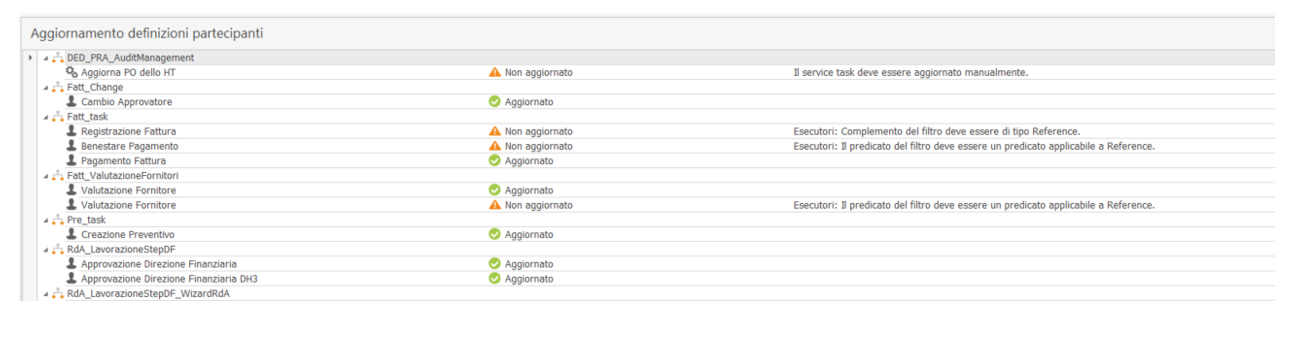
For mass conversion “Update Participants” button available in Jamio Composer.

At the end of the procedure, the dedicated panel will display the updates completed successfully and those that need to be performed/completed by the designer. In these situations, the recommended solution is to define a group and add it to the reference list.
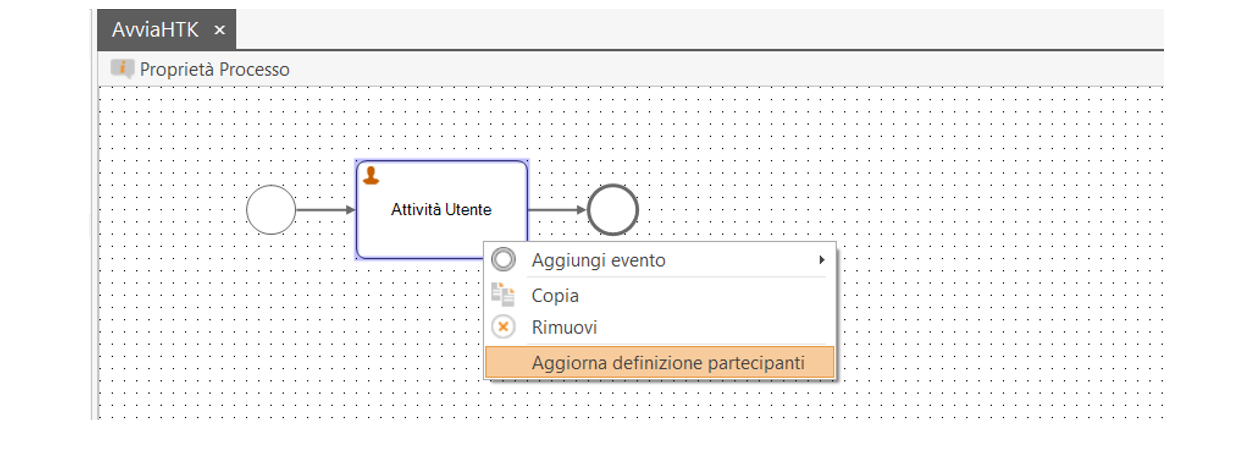
To convert a single Human Task , you need to select it in the process model drawing, right-click, and select Update Participant Definition . You'll also receive a message if the automatic update fails and you need to manually update it.
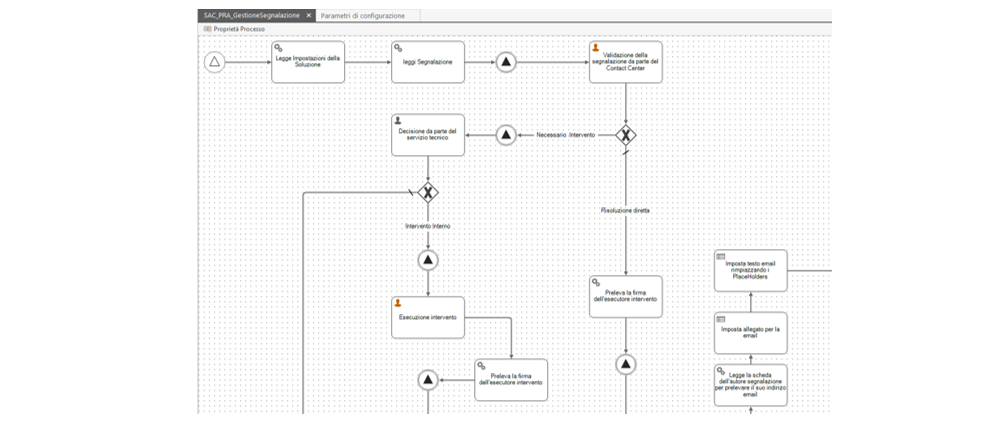
Human Tasks that have not yet been updated are marked with an orange icon in the Jamio Composer process model. Additionally, during validation , they are flagged with specific warning messages .
No. For new solutions or simply for new Human Tasks in existing solutions or processes, Jamio Composer will only make the new reference list mode available.
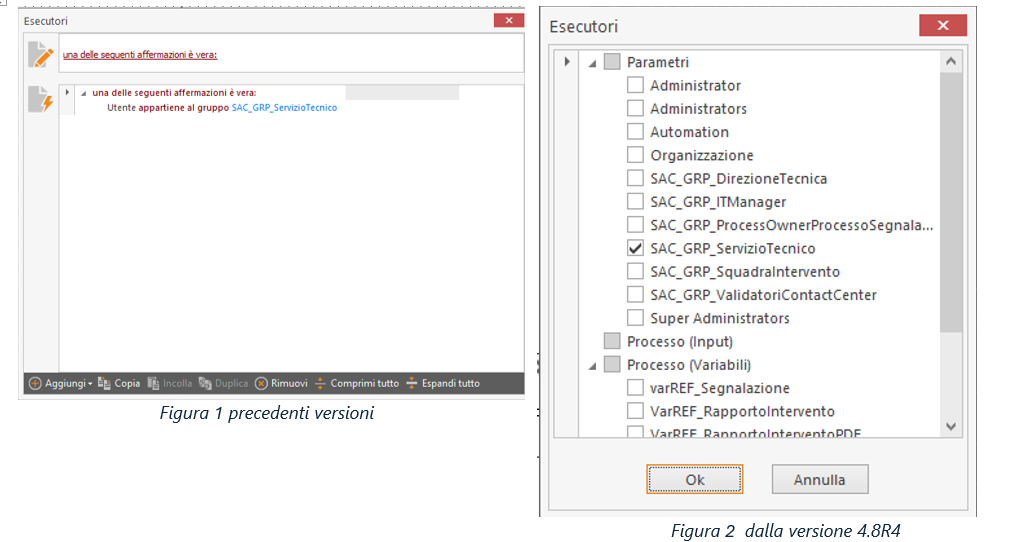
The designer, accessing the same configurations as the already known participants, will have to select Reference, ExtendedReference (basic type and custom type) or lists of them, already defined among the configuration parameters, process or activity variables, input and output variables of the process:
Yes, some Jamio services related to Human Task management have been deprecated and no longer available in Jamio Composer, although they continue to run at runtime on unupdated instances, and have been renamed to something else .
These are the substitutions made:

During validation Jamio Composer will display warnings when it detects the use of obsolete service names.
It will be the designer's responsibility to maintain consistency by ensuring that such services only act on Human Task instances with the old definition.
However, the platform tries to avoid error situations: for example, if you use the UpdatePotentialOwners method (which expects a filter like PotentialOwners) on a HT that has the new definition, the platform attempts to transform the filter into a reference list. If this is not possible, you will get an error.