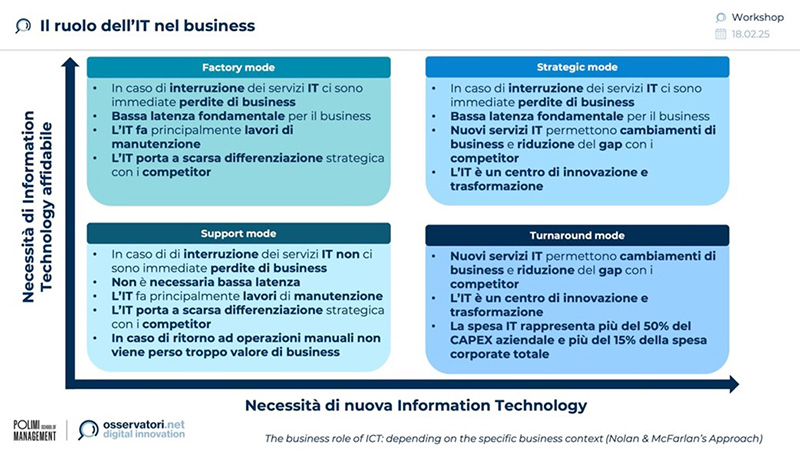
The model, formalized years ago by academics at Harvard Business School and still widely used today to help companies manage their IT portfolio and make strategic decisions about digitalization and application modernization, classifies information systems within an organization based on their strategic impact, establishing four categories:
Support or systems with a limited operational role , not critical to the business and with low strategic impact, such as, for example, basic accounting software, simple document management, etc.
Factory systems are to the company's daily operations and, if problems arise, have an immediate impact on productivity, such as ERP for managing production operations.
Turnarounds are systems with high strategic potential but currently non-essential. They may become essential in the future with adequate investment. Examples: AI or blockchain pilot projects.
Strategic , or systems that are essential to the company's competitive success. For example: advanced e-commerce platforms, CRM with predictive AI, business intelligence, automation platforms, and complex process orchestration.
The Observatory's research helps identify the criteria to follow when prioritizing IT investments based on their strategic value: the red arrow in the figure identifies the direction of growth.
Once decisions have been made, it then becomes essential to deal with a series of challenging aspects:
- Measuring the impact of cloud spending on business value:
The shift from CAPEX to OPEX requires new monitoring and control tools: it is essential to find metrics that demonstrate the actual value of Cloud spending compared to business productivity.
- Balancing cost and innovation agility
The scalability and agility offered by the cloud can lead to hidden costs. Adopting financial management models based on Unit Economics allows you to evaluate the true impact of innovation, avoiding inefficiencies in resource allocation.
- Effectively integrate AI into enterprise IT systems
Artificial intelligence plays a key role in managing cloud processes. However, critical issues have emerged, such as the risk of lock-in with AIaaS providers and the need for proprietary AI models to ensure greater control over data and security.
- Addressing the issue of skills
One of the biggest barriers to cloud adoption is the skills gap. The importance of ongoing training and the introduction of specific roles, such as the Cloud Center of Excellence (CCoE), to drive business transformation has been discussed.
- Avoid vendor lock-in and manage multicloud
The cloud market is dominated by a few large players, and the risk of dependence on a single provider is increasingly significant. Multi-cloud and hybrid-cloud strategies have been discussed to ensure greater flexibility and resilience, avoiding being tied to a single platform.
The closing discussion , well attended by the audience of qualified representatives from both the supply and demand sides, highlighted that to successfully undertake Cloud Native transformation, companies must measure the impact of Cloud spending on business value and innovation agility, find the right balance with costs, and manage the transition from CAPEX to OPEX . An effective approach involves engaging teams outside of IT to validate the value of Cloud solutions , employing independent partners to measure the economic return, and defining KPIs capable of evaluating not only costs, but also the impact on productivity and the digitalization of business processes .
Integrating AI into enterprise systems, for both business users and IT, represents a strategic lever but poses complex challenges , from managing data ownership to mitigating the risks associated with AI model hallucinations. Enterprises can adopt Private AI solutions to ensure greater security, leverage AI agents for cloud management, and assess the energy impact of these technologies from the design stage.
Finally, to leverage Cloud Native as an innovation driver , it's essential to avoid lock-in with a single provider and adopt a gradual approach to migration, avoiding simple lift-and-shift strategies. Cloud is not just a technological enabler, but a tool for reducing time-to-market , experimenting at low costs , and fostering innovation through rapid prototyping with no-code solutions . Only by adopting these strategies will companies be able to fully grasp the potential of Cloud, transforming it into a sustainable competitive advantage.