





 Editorial by:
Piero Cosoli – Senior Program Manager Openwork
Integrated Health Platform: Integration Makes the Cure
The intensification of significant demographic trends, including the progressive aging of the population, and the shift in morbidity toward a greater incidence of chronic diseases are changing (and will significantly change) the characteristics and intensity of citizens' social, health, and care needs. The most advanced approaches place the patient at the center of a diagnostic-therapeutic-care pathway (DTC) , ensuring continuity even if parts of this process may be carried out in different locations, by different professionals, at different times.
PDTAs represent a clinical and organizational management tool used to define the best diagnostic-therapeutic-care process at responding to specific health needs on the basis of recognized recommendations (guidelines) adapting them to the local context, and, in particular, to the organizational processes and available resources with the support of appropriate digital technologies that facilitate their adoption, management and verification of the results.
The effective use of ICT tools , in fact, represents a truly powerful solution for managing the continuity of healthcare , in managing care processes , in sharing and managing healthcare documentation, in supporting and monitoring the patient during the diagnostic and therapeutic path in which he is inserted.
Digital technologies are an enabling factor in many areas:
- promoting access to prevention services (e.g., apps for monitoring lifestyle or screening, etc.)
- facilitating communication between healthcare professionals and reducing the risk of errors (e.g. electronic medical records, PDTA pathways, etc.)
- making it increasingly easier, through the Internet and mobile networks:
- Doctor-patient dialogue (e.g. televisit, teleconsultation)
- the collection, networking, remote monitoring of medical information and its use (e.g. telemonitoring of vital signs)
- The integration of different mobile devices,
- The accuracy and security of the data,
- The dialogue between the different apps and the social health information system
- making innovative technologies available to users (e.g. IoT, wearables,) and to clinicians (robotics, decision support for diagnosis, etc.)
- making care pathways more controlled and efficient (e.g. PDTA pathways, etc.)
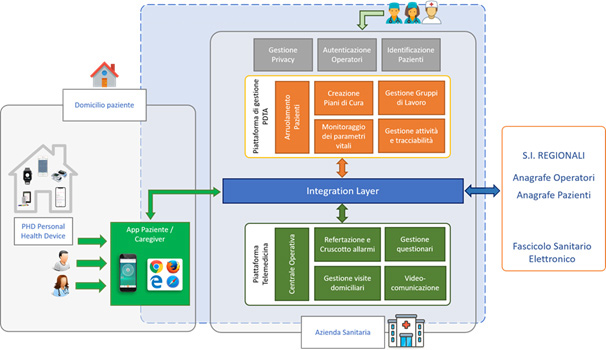
Architecture of an Integrated Health Platform
A holistic approach includes the definition of an ICT health platform as an integrated ecosystem of the 3 application components illustrated in the figure.
- PDTA modeling and management platform based on the BPM Platform
- telemedicine and teleconsultation platform multi-channel communication platform extended with a mobile interface that allows its use also from the territory and with data acquisition connectors from medical devices allocated at the patient's home.
- An integration layer open to interoperability with regional health systems and with other information systems according to standard protocols
The health platform state-of-the-art integration and security requirements,
- It has a web-based architecture and a responsive user interface
- It exposes its core services through RESTFul API interfaces
- It complies with the security and safety requirements of the GDPR
- Manages security through appropriate authentication and authorization mechanisms and role-based information visibility policies
- It is integrable and interoperable with other healthcare systems
- It can be extended, without programming interventions, to manage other clinical flows
- It is compliant with HL7, FHIR, XDS, CSV, XML, Web services and APIs standards.
Jamio openwork platform has been used as a BPM platform PDTA management projects in the field of heart failure and neurodegenerative diseases for the modeling and monitoring of customized care pathways for the patients taken into care.
2020: Big Data and Cybersecurity at the forefront

Interesting new perspectives for 2020 in terms of digital innovation, as illustrated by research carried out by the Digital Transformation Academy Observatories and by Startup Intelligence of the School of Management of the Milan Polytechnic , in collaboration with PoliHub.
The extrapolated data shows that large companies will primarily allocate digital investments , particularly in the current hottest times: especially Big Data and Cybersecurity .
Unfortunately, investments by SMEs , with only 23% compared to the 45% expected by large companies. Also noteworthy is the significant introduction of the professional role of Innovation Manager , a role increasingly taken into consideration, especially given the incentives promoted by the government to accelerate the digital transformation of Italian industry and bring it up to par with that of other European countries.
Cybersecurity was the focus of our December issue of BPM Magazine No. 15 ( editorial by Alessandro Cortese, Cloud Architect at Openwork); a highly interesting topic, especially suited to companies that manage large amounts of data and require appropriate security measures to protect them from illicit tracking or hacker attacks.
So, there are lights and shadows on the digital prospects of 2020 , with large organizations always at the forefront to make the leap in quality and SMEs that instead gradually react to the changes imposed by the market by giving small and slow signs of growth.
Innovation is built in-house:
the interesting case of a company operating in the healthcare sector
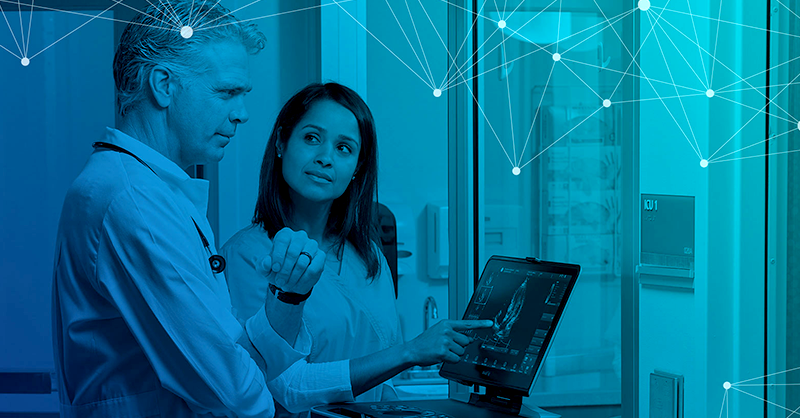
Among the interesting stories of Digital Transformation , here is a success story originating from the integration of a BPM Cloud platform . This is Predict , a company that markets ultrasound and radiology diagnostic imaging systems and develops innovative technologies in the healthcare sector.