




While it's true that 2020 was the year of collective awareness, particularly among SMEs , of the need to take a concrete step towards digitalization , it's also true that this profound change, which would enable businesses to open up to new avenues and opportunities, is still struggling to take shape.
Small and medium-sized businesses, in fact, are still in the early stages of digital transformation , despite generating approximately 41% of national revenue and ranking among the country's most powerful businesses. The negative effects of the pandemic have spared no one, which is pushing SMEs, especially those who are already experiencing it, to undertake organizational and technological reorganization. While commonly believed to be essential, in reality, several mechanisms still hinder their implementation.
The reasons are many and not solely attributable to economic factors. The government has also provided a fundamental boost to digital transformation with the National Recovery and Resilience Plan (PNRR) , a strategic plan that allocates 27% of the approximately €222 billion budgeted for digital transformation . Other hurdles to overcome concern the cultural aspects of digital technology, as well as the skills needed to confidently address the change and sustain it over time.
But what does “change” in digital really mean?
A term that has always been subject to differing schools of thought, where, on the one hand, it is understood as a leap into the unknown and, on the other, as a step toward a range of new challenges and opportunities. A clear division, therefore, that is enshrined in society as the digital divide and that is slowing the country's growth toward increasingly necessary digital maturity .
This latter concept, the Digital Innovation Observatory for SMEs recently attempted to interpret to better understand the levels of digital maturity of Italian small and medium-sized enterprises (SMEs). A survey of 1,038 companies was conducted, which revealed an undeniable acceleration toward low-level digitalization, limited, therefore, to immediate business operations in response to Covid.
In fact, the extrapolated data shows that approximately 43% of the companies interviewed are still unable to find a real start-up, nor to assume strategic from a business and planning perspective. The Observatory has therefore identified some indicators to outline a clear division of the digital approaches adopted by companies :
Analogue Approach
Includes those SMEs that still manage internal processes manually (7%), that are not familiar with ERP technologies (58%) and that consider digital investments too expensive (71%)
Timid Approach
Includes those SMEs forced to digitalize some processes by laws and regulations - think of electronic invoicing - or by the new needs triggered by the pandemic (40%)
Convinced Approach
These are those SMEs that, in addition to having digitalised various business processes, also show a strategic and long-term approach with the help of new technologies (44%)
Advanced Approach
It concerns the most forward-thinking Small and Medium Enterprises, with an openness towards global markets and supported by a good mastery and knowledge of digital technologies (9%)
Although digitalization is a topic that has been discussed and discussed repeatedly at numerous workshops, highlighting its undeniable advantages , it is still difficult to fully understand its implications. To launch a digital transformation , it is essential to first clearly define the direction you want to take, but above all, to fully understand the complexity that can be inherent in the digitalization approach you intend to adopt within your organization.
Hypothesizing a "digital maturity ladder" can help better understand the level of a company that wants to undertake (or has already undertaken) a digital growth program and what the differentiating elements are that allow it to leap from one step to the next.
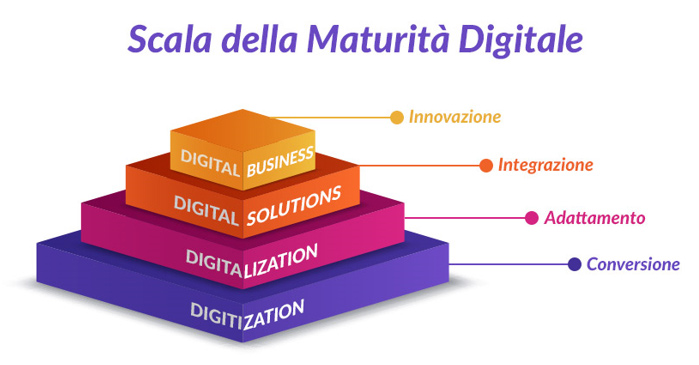
According to the proposed scheme, we can imagine that the path towards digital maturity starts from a level of Digitization , then continues with Digitalization , to rise to the level of Digital Solutions and finally reach Digital Business .
Let's look in detail at what each of these steps entails.
The first step, Digitization , includes all those organizations that equip themselves with basic tools to streamline their work methods. We're talking about the use of individual productivity tools like Word, Excel, and email , or the creation of websites. This represents a shift from physical/paper-based operations to a similarly virtual one.
Digitalization brings with it the concept of adaptation: business areas organize themselves to improve their operations by reducing costs and transforming "physical processes" into more efficient, automated, or semi-automated virtual ones.
When we talk about Digital Solutions, we're referring to the concept of integration. Integration not only between organizational units, but also one that adds value to people's work, to the relationship between the organization and, for example, its customers, enabling a digital continuum that transcends corporate boundaries.
Only the final step, however, that of Digital Business , brings with it the concept of Innovation, perceived by corporate owners as a means of profit. The organizational model undergoes a digital overhaul that is light years removed from the mere introduction of applications into the organization.
To achieve digital maturity across your entire business and differentiate yourself in the market, it's essential to understand your company's current position, plan the level you want to reach, and adopt technologies and methods that can transform your strategy into action. This will help you reach your desired level of digital maturity and scale it up gradually.
A strategic approach allows any organization to grow and, therefore, not be stuck on just one step towards digital maturity; a technology like Jamio allows companies to push themselves to ever higher levels without costly investments, thanks also to the application development tool provided by the platform. This allows, without knowing programming languages (no-code development) , the rapid modeling of application solutions and their adaptation to the organizational context.
The more digitally mature the company becomes, the more Jamio evolves towards a new maturity.
A boon for businesses that want to grow rapidly without incurring additional technology costs, since the scalability of the Jamio cloud platform allows it, with the use of business language replacing programming codes and the cost of a subscription rather than multiple individual investments .
Editorial by:

Ivan Giuliani
Marketing & Digital Coordinator Openwork

Rita Genchi
Sales & Marketing Specialist Openwork
Numera chooses Jamio's No-Code to build its software solutions
Numera Sistemi Informatici Spa is an IT services company part of the BPER Banca group with over 50 employees and a network of consultants and collaborators who are activated from time to time depending on specific project needs.
Jamio's no-code approach processes and custom software solutions sustainable cost.
The Jamio community is born on GitHub
 Discover the new Jamio community on GitHub ! This repository offers a range of free solutions developed by Jamio's developers to get you up and running quickly in managing your processes, or to use as a starting point for quickly creating fully customized cloud application solutions tailored to your needs.
jBIZ | Business Digitalization According to Jamio:
Human Resources Management in the Industry 4.0 Era

Even within human resources management, it's possible to identify and define processes , some highly recurring, that involve most, if not all, people in the organization. They involve data entry and the circulation of information and documents, and mostly involve approval or validation cycles , such as managing an expense report, requesting leave, or sharing a paycheck or resume.
Errors, delays in completing procedures, lack of control, and difficulties in sharing information are the associated critical issues, critical issues that directly impact the people involved and indirectly the organization's business.