








PREMISE
Many business processes in organizations are inter-enterprise or cross-business , meaning they extend beyond the boundaries of the organization .
These processes may include collaboration and information exchange between companies or entities to create value for all involved. Examples include supply chain management involving suppliers , but also customer relationship management , business partnerships ( with partners or agents), intercompany collaboration , shared logistics , project coordination between different organizations, or even some recruiting .
It's not always easy to be fully aware of managing a process that extends across your organization. And when you're trying to streamline the process with the support of IT tools, even going as far as digitizing it, you might tend to ignore the part of the flow that involves external entities or organizations. However, even if this doesn't happen, this represents a crucial point in management .
Effective management of these processes is achieved by using appropriate tools that allow for the management and monitoring of the entire flow, avoiding multiple systems and information redundancy. This also increases efficiency by outsourcing activities that would otherwise be performed internally.
In this issue we try to find out how, looking at the use case of Quote Management of interest in the supply chain - procurement .
ORGANIZATIONAL NEEDS
Let's imagine we're on a construction site. In this context, as in many others, the materials procurement process requires careful planning, diligent management, and effective communication with suppliers to ensure the success of the construction project. The key is to manage the initial phase of this process, namely supplier evaluation .
Once the materials that need to be procured have been identified, an organization's purchasing department needs to request a quote for the same supply from N potential suppliers, asking each for both the quote and other information, in order to make a correct evaluation.
The simplest and most commonly used way to manage this process is the following, where all the activities are entrusted to a purchasing office operator who:
1) define the list of materials in an Excel table;
2) composes a request for quotation letter in Word or another tool, including the details of the requested supply;
3) compose a generic email attaching the request and send it N times to various recipients or use the BCC;
4) waits for the N recipients to respond via email;
5) collects the individual responses, as they arrive, in a folder;
6) analyze all the answers;
7) aggregates the information obtained in a comparative table.
This flow uses individual productivity tools such as Word, email and Excel which, while supporting the operator, still leave him the owner of everything.
Suppliers participate indirectly in the flow, but they operate independently, and the information they provide requires further processing. This results in significant time wastage and potential errors .
THE SOLUTION
By trying to manage this flow with a process automation like Jamio, we obtain complete end-to-end automation of the process, including the collection and aggregation of responses from external parties, with significant advantages in terms of time and costs, among other things.
The flow described above becomes the following.
The purchasing office operator:
1) defines the list of materials in a specific tab in the system and indicates the recipients by selecting them from a list, always in the same interaction tab;
2) Click a button to delegate all the rest of the tasks to the system.
The system, in complete automation:
3) automatically composes the request for quotation letter, customized for each supplier;
4) create a questionnaire for the supplier, and provide a link to it;
5) automatically composes the accompanying email, personalized for each supplier, inserting the link to the questionnaire and attaching the letter requesting the offer and sends it;
6) monitors the completion of the questionnaire, collects the results and reports them in the request form;
The purchasing office operator can thus simply and exclusively:
7) consult the results and information collected in real time, always in the same interaction sheet.
It is clear that all those human activities that involve a waste of time and margins of error are thus delegated to an IT system, such as filling out the request for quotation or the email, starting from predefined templates, or the collection and aggregation of responses.
Furthermore, external stakeholders, such as suppliers, actively participate in the process, as the supplier inputs their information in a guided manner into an object—the questionnaire—orchestrated by the system. This allows for real-time access to the results directly in the system, without the need to distribute credentials to the supplier.
THE ADVANTAGES
- reduction of management times
- error reduction
- increase in branding reputation towards suppliers
- Instant sharing of data and documents
- Employment of operators in higher value-added activities
- Organizational efficiency


In March 2023, Ciheam Bari launched a challenge in collaboration with the Apulian IT Production District. The aim was to understand the methods and tools needed to prevent risks in the agricultural sector by exploiting the vast amount of data that new technologies can collect.
The challenge provided an opportunity to enhance the digital skills of 30 selected young graduates from various nationalities, including Albania, Montenegro, Egypt, and Italy. They were working to redesign tools and processes to enable farmers and producers to prevent crop-related risks.
During the 3-month training course, the students were supported by 20 companies, including Openwork , which involved them in 6 project works.
The challenge posed by Openwork in the field of Agriculture 4.0 is summarized in the question: ' How can we best integrate all the data relating to irrigation activities to guarantee the best Customer Experience from a service design perspective? '
The aim was to provide a starting point for the design and application of the various DT ( Design Thinking ) tools, describing the design context, the actors involved and the objectives.
The choice of the theme was made considering that:
- Agriculture 4.0 uses innovative technologies, such as the Internet of Things (IoT), to improve the productivity and sustainability of the agricultural sector. Analyzing data generated by IoT devices can help farmers detect anomalies that could indicate problems or risks to their crops;
- Digitalization allows for faster response times, structured response procedures, refined response methodologies, and the management of the risk management cycle through the detection , response , and prevention . The use of no-code technologies enables incremental and continuous improvements;
- Earth observation with satellite remote sensing data can be considered part of an IoT system that adopts video surveillance from space. Through satellite monitoring, it is possible to identify vegetative anomalies that can be used to optimize management processes according to the principles of Precision Farming .
The mentor appointed by Openwork, Philip Vitale, allowed the students to carry out analysis and development activities until they developed a Jamio POC (Proof Of Concept) which, integrated with an irrigation system, takes care of:
- make it easy for farmers and producers who do not yet have experience in the digital field to manage and read data
- be Anomaly detection , that is, able to respond quickly to anomaly situations by mitigating the risk or damage
"Digital technology has changed and will continue to change our lives, but this is a cross-cutting sector. Only by working together will it be possible to reach new markets and take a leading role in a global challenge that we must address not in isolation but hand in hand, moving along a Mediterranean path, a path toward development," said Alessandro Delli Noci, Councilor for Economic Development of the Puglia Region, speaking at the Project's closing event, which saw the participation of several regional and national institutions.



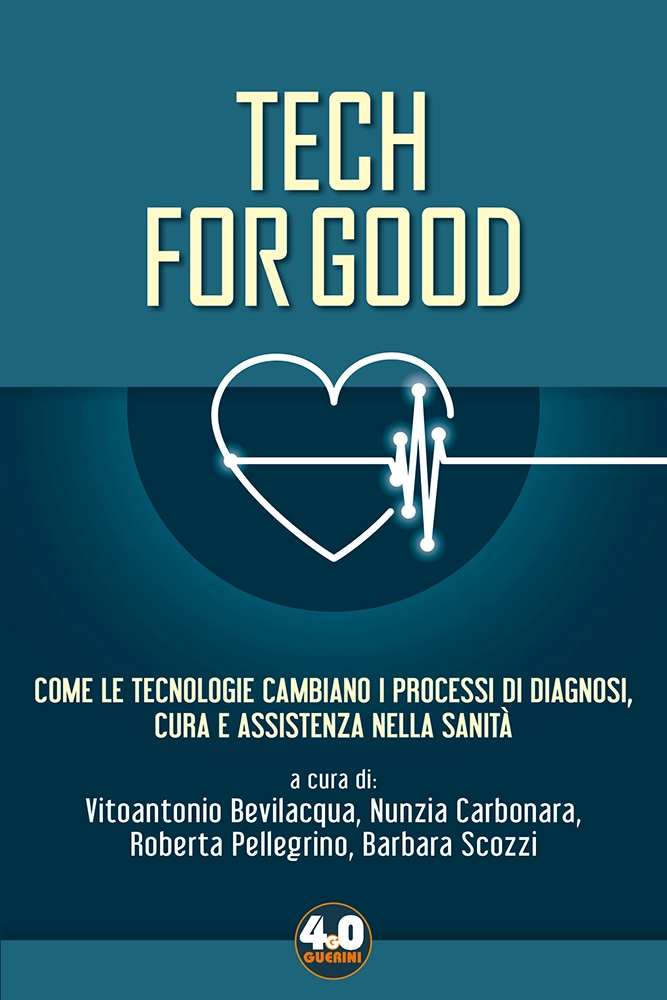
Recently published by Guerini e Associati Guerini 4.0 series the text Tech For Good – How technologies are changing the processes of diagnosis, treatment and assistance in healthcare consists of a collection of 10 use cases selected to exemplify the changes underway and the economic, social and clinical-health benefits obtained by the respective healthcare facilities thanks to the interventions implemented.
Two of the 10 cases were implemented thanks also to the intervention of Openwork and its Jamio openwork technology.
The first is the case of the IRCCS Casa Sollievo della Sofferenza , addressed in Chapter 4 entitled Innovation of care processes: the case of patients affected by multiple sclerosis, written by Maurizio Leone of the IRCCS, Angela Nuzzi and Barbara Scozzi of the Polytechnic of Bari, and Martin Arborea of Openwork.
The second is the case of the Center for Neurodegenerative Diseases and the Aging Brain (Tricase) led by Prof. Logroscino, discussed in Chapter 5 entitled Web Platforms for the Multidisciplinary Management of Patients Affected by Neurodegenerative Diseases, written by Giancarlo Logroscino, Salvatore Nigro, and Marco Musio of the Center and Martin Arborea and Nicola Altieri of Openwork.
Both works highlight the value of the no-code approach applied to the healthcare sector.