



A crisis forces us to return to the questions; it demands from us new or old answers, provided they arise from direct examination; and it turns into a catastrophe only when we try to face it with preconceived judgments of any kind, that is, prejudices.
"Between Past and Future" by Hannah Arendt
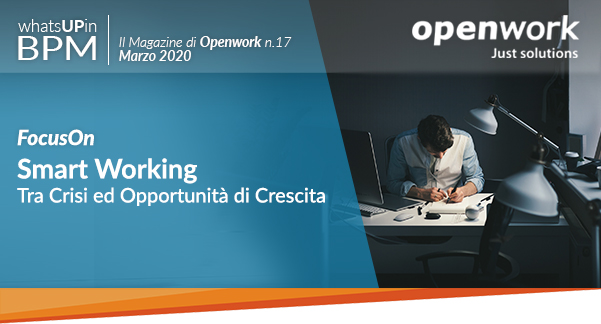
Smart working: the opportunity to be truly smart
Starting from a naive definition of smart working as a way of working without constraints on time or location, with the help of technological tools we can easily affirm that smart working has been done for a lifetime, even outside our organization.
Thanks to the help of various technological devices , we organize daily meetings in virtual environments, web-based, or via email and telephone, with potential leads, clients, and suppliers; we coordinate projects within a network of partners, without moving a meter; we manage more or less complex objectives , regardless of working hours.
So, if this agile of working is possible across different organizational settings, with procedures and ways of working that aren't aligned with each other... why shouldn't it be possible within the same organization?
Let's consider the systemic approach to organizations that defines an organization not as a VAT number that contains within it economic and legal relationships with its collaborators, but:
- as an open reality capable of adapting to changes in the environment, which is characterised by a high level of dynamism in its relationships with the outside world but also within itself, at the level of subsystems of different nature and degree of complexity (Von Bertalanffy)
From this perspective, the physical workplace has no reason to exist, given that one is constantly distant and already external to many organizational relationships. Once the prejudices related to control and performance timing have been overcome, we can look at the true aspect of smart working: working by objectives.
This approach can, in many cases, be perfectly combined with traditional on-site work, creating a hybrid and flexible (and therefore even smarter ) model that enhances the advantages of both.
Innovation: a lever for growth
The current pandemic has suddenly forced millions of people into isolation and caution, first in China, then in Italy, and gradually across the rest of the world. The need to reduce the spread of the virus has immediately led to the widespread adoption of smart working to reconcile social responsibility with the need to continue organizational activities.
Riccarda Zezza , CEO of Life Based Value, writes in the Alley Oop column of Il Sole 24 Ore that "we're not in smart working, but in a rare (hopefully) case of extreme smart working ," working from home in a stressful with overlapping needs and activities, all forced into the same living space 24/7. This is a testing phase that goes far beyond adopting agile working in "peaceful" times. If it works now, so much the better. Companies already accustomed to smart working before the emergency situation will likely now gain a significant organizational and competitive advantage over companies less accustomed to these practices; certainly, companies that were considering adopting such a methodology have had an extra push to do so, while those companies that have always been skeptical of the topic will have had to overcome their prejudice in order to continue their business.
It is therefore time to transform a moment of crisis into an opportunity , trying to pay attention to what the Smart Working Observatory of the Milan Polytechnic defines as the four fundamental pillars of Smart Working : reviewing the organizational culture , flexibility with respect to working hours and places, technological and physical spaces .
Mariano Corso, scientific director of the Smart Working Observatory at the Polytechnic University of Milan, explains that "smart working is a work organization model based on greater worker autonomy . By fully leveraging the opportunities offered by technology, workers can redefine their working hours, locations, and, in part, their professional tools. It's a complex concept, based on critical thinking that restores worker autonomy in exchange for accountability for results."
In this sense, smart working has been included in the Jobs Act as a measure to improve corporate efficiency. According to the most recent findings from the Smart Working Observatory, it is estimated that adopting a "mature" smart working model can produce a productivity increase of approximately 15% per worker . The projected increase in average labor productivity for the country would be around 13.7 billion euros .
Obvious considerations then arise on other positive aspects at an organizational level such as the reduction of absenteeism , the elimination of overtime , meal vouchers or petrol vouchers , the reduction of costs for physical spaces, the reduction of expenses for company hardware, thanks to the adoption of the BYOD (bring your own device) approach, which brings with it a further advantage: generally the devices and technologies owned by individuals are generally more advanced and latest generation than those made available by corporate organizations.
We will not go into the specifics of the global , such as the reduction of pollutant emissions the personal impact, such as a better work-life balance .
Smart Working: the transformation underway
The possibilities for implementing smart working vary based on several factors, such as the product sector (goods vs. services), the type of organization (public vs. private), the size of the company, and also the roles of smart workers.
Corso also emphasizes that approximately 60% of medium-large companies in our country have introduced smart working initiatives, resulting in concrete benefits for companies and individuals.
A lower percentage, approximately 40% , of SMEs (between 10 and 250 employees) have introduced or are considering introducing smart working initiatives (of which only 8% have already implemented initiatives). This, according to Corso, is partly due to organizational culture : smart working presupposes a new leadership style, with managers capable of planning activities, monitoring results, and providing feedback and above all, independent of the concept of physical presence.
Technology as a driver for Smart Working
Technology and digitalization often appear as key factors in fostering a Smart Working project. Digital innovation thus becomes a tool for integrating different areas and functions and for fostering collaboration among individuals in particular and between organizations in general. When we talk about Digital Transformation in the workplace, we also think of the application of advanced technologies to connect people, spaces, and objects to business processes, with the goal of increasing productivity , innovating, and engaging individuals and workgroups.
We can consider today's workers as native smart workers, with a level of preparation and openness to innovation that was once unimaginable, thanks to the spread of extremely advanced and daily used individual technological tools (smartphones, tablets, laptops).
This, together with the increase in organizational profit that can be achieved, should lead even the most conservative of companies to lean towards adopting this model, even partially.
According to the Smart Working Observatory at the Polytechnic University of Milan, the most widely used solutions are those that support data security and accessibility remotely mobility initiatives , which include mobile devices and mobile business apps social collaboration services (61%). Digital technology allows the workspace virtualized digital workplace where communication, collaboration, and socialization are independent of work hours and locations and where processes are managed and monitored. The distinction between internal and external to the company becomes irrelevant for achieving organizational objectives.
Smart working technologies must guarantee:
- Collaboration : Integrate and support communication flows, creating new opportunities for relationships, collaboration, and knowledge sharing, limiting travel for meetings where physical presence is not essential.
- Security : flexible, simple and immediate access, regardless of the device used, to a profiled environment containing applications, data and information in total security and preserving data integrity (access via Virtual Private Network and Cloud-based solutions)
- Mobility : access to professional services and tools at any time and from any location, both inside and outside the workplace (see BYOD policy).
- Workspace Technology : more effective and flexible use of physical environments, not only facilitating the usability of the spaces themselves, but also supporting people's mobile working and improving the quality of life within company offices (e.g. Wi-Fi and centralized Print Area systems)
BPM and Cloud: Transforming Critical Issues into Opportunities
We've seen how employing innovative technologies and working methods that foster collaboration within an organizational system "in times of peace" can be an advantage that helps trigger a smart working plan when needed.
The technology that can simultaneously guarantee innovation and constant updating, mobility, secure access, and the creation of a virtual workplace that transcends the physical office space is undoubtedly the cloud . Adopting cloud technology addresses some of the concerns of companies, such as the difficulty of communicating and managing tasks remotely, data security update technology.
In the TCO (Total Cost of Ownership) of cloud technology, and therefore in its fundamental characteristics, updates are not a customer issue but a must for the service provider, who also ensures updates without impacting the work of those who have adopted their technology. Remote connections require a simple internet connection, without having to activate antiquated VPNs , since security is fully managed and is a core concern for the service provider.
But what should be brought to the cloud? How can collaboration be enabled within the company, but also with suppliers, customers, or partners? The best strategy is certainly Business Process Management, which enables the formalization and digitization of organizational processes . The advantage of digitization lies in the ability to get to work from the comfort of your couch, perform complex interactions while tracking all the common threads of activities, authorize tasks, and manage complex projects with multiple people, even when remote from one another. Revising processes and bringing them digital also allows you to streamline and optimize obsolete ones, thus generating additional benefits that can be added to the 15% profit derived from simply working remotely.
cloud BPM technology .
For large companies, already ready for the BPM , but scared of managing cloud security IaaS of one of the major players in the sector (AWS, Microsoft Azure, Google Cloud, Aruba).
For SMEs collaboration and task management difficulties BPM-oriented approach is satisfies, through the possibility of monitoring the activities carried out, defining process transition times , viewing the status of activities , managing remote work and much more.
Jamio openwork , as a BPM technology on the Microsoft Azure Cloud , guarantees its customers the management of issues related to security, collaboration and mobility, breaking down the walls of the organization and enabling the development of a smart work organization.
Furthermore, the zero-code allows, even in emergency situations, to quickly and independently new processes and include new workers in remote collaboration.

Editorial by:
Rita Genchi – Sales & Marketing Specialist Openwork
Jamio is increasingly connected: integration options simplified in the new Jamio release
The new version of Jamio openwork: MARIMBA 4.5 R5 has been released. This brings many important new features for Jamio developers, particularly those aimed at expanding and simplifying integration with third-party systems.
Here are the main new features introduced:
- Improved integration tools for Jamio developers system integrators . The REST Open API Gateway to make it easier to create and use clients that interact with Jamio openwork services.
- The Jamio openwork Admin Console Beta version . In this Beta version, you can download the swagger descriptor for the templates installed in an area.
- The Jamioplug Message to enable regular email as a transmission channel for sending and receiving information. This will make it easier for designers to integrate emails and manage , multi-recipient emails .
- Helpful features have been introduced to facilitate design , including:
– A new connector for creating and managing Jamio Groups via process templates.
– New methods for obtaining .zip files of document file components and files attached to a resource.
– New OEL functions, including some useful for manipulating text and text lists. - Bug Fixing
CONTACT Project: Remote monitoring of multiple sclerosis patients is now possible. The trial has begun!
"CONTACT", Openwork as technological partner and project coordinator.
Testing is currently underway for "CONTACT" , an acronym for Cooperation and integration of clinical trial and care pathways" , a major e-Health funded by the Region as part of Innonetwork (a program that promotes the creation of public-private technology partnerships for the development of innovative solutions on a regional scale), for the remote management and monitoring of patients with Multiple Sclerosis .
It is a digital platform that allows the healthcare facility to manage the clinical pathway of patients , specifically managing treatment processes , sharing information and related documentation and monitoring patients remotely throughout the diagnostic and therapeutic pathway.
A scientifically, clinically and technologically relevant project
"The Contact project partnership, consisting of leading regional ICT companies, the Polytechnic University of Bari, and the IRCCS Casa Sollievo della Sofferenza," explained Piero Cosoli, project coordinator , "represents a virtuous example of a regional system collaborating to promote and adopt the most modern ICT technologies. The partnership itself is a knowledge pipeline for the development of solutions in the strategic area of citizen well-being and health."
THE ROLE OF PATIENTS
After a brief training period and equipped with the necessary technological equipment connected to the network, patients will measure their vital signs, such as blood oxygen saturation, blood pressure, body temperature, heart rate, and sleep quality, directly from home; all recorded using a standard smart bracelet .
These values are then sent, via an app installed on the patient's phone , to a digital platform accessible remotely by doctors and healthcare professionals involved in the treatment process.
REMOTE MONITORING
Following enrollment, patients, assigned to specific treatment plans tailored to their current drug regimen, will be monitored and supported remotely for the entire duration of the trial, including through chat or video calls with their physician. This will allow hospital staff to monitor patient adherence to the prescriptions and make any necessary adjustments to the treatment, based on identified needs.
THE DEDICATED APP
A key role in the platform is played by the dedicated app that the patient must install on their smartphone . It retrieves and transmits data to and from the platform, sends reminder notifications for activities to be completed, and manages the teleconsultation during the time slot agreed upon between the patient and healthcare provider.
"By orchestrating the various systems, the platform will facilitate adherence and monitoring of the treatment pathway for MS patients treated at our Center," explained Maurizio Leone, head of the Neurology Unit at IRCCS Casa Sollievo della Sofferenza . "Furthermore, by collecting and submitting data, values, and measurements, patients become active participants in the management of their treatment and clinical trials. Through the constant monitoring of certain biological parameters, with the essential input of patients, we will be able to modulate and improve the treatment pathway, adapting it to the different needs of each individual."
THE PROJECT PARTNERS
CONTACT is a project to which eight Apulian partners , including startups, companies, and public and private research institutions. The IRCCS Casa Sollievo della Sofferenza in San Giovanni Rotondo—a healthcare facility created and inaugurated by Padre Pio on May 5, 1956—is the clinical partner that developed the digital platform's requirements and initiated the trial by involving patients and healthcare professionals.
The other 7 project partners are:
• Openwork srl ., Bari, project leader, IT company specialized in the development of Business Process Management solutions
• Sincon srl , Taranto, IT company dedicated to the development of digital solutions for public administration and healthcare companies
• SER & Practices srl , Bari, company specialized in telemedicine and the development of digital solutions that involve the use of IoT devices
• Euronet srl , Grottaglie (TA), company dedicated to the development of IoT solutions
• Informatica e Telecommunications I-tel srl , specialized in the development of telemedicine solutions and, in particular, mobile applications for e-Health
• Politecnico di Bari , Bari, with units involved in CONTACT in the sector of Adaptive Case Management methodologies and Big Data analysis
• Golem Plus srl, Bari, innovative Start Up for the production of Software in the Healthcare and Public Administration sectors