






CASE 4 – Onboarding Management
Human Resources Area
Organizational needs
In extremely dynamic corporate environments where hiring flows are frequent and extensive, it's important that various operations are carried out quickly and efficiently, with attention to procedures and regulations, but also with great care for the prospective employee. That's not all: the recruitment and selection process is a lengthy one that may involve the participation of multiple owners and the use of different systems . From the preliminary screening to the ongoing management of the candidate, their data may be passed through two, three, or even more systems, often by copying and pasting, or certain information may be requested repeatedly.
To fully understand the need, let's quickly review the typical onboarding process, placing it in the entire recruiting flow and subsequent management of the workforce :
candidate search phases , often supported by recruitment, screening , selection and evaluation , we reach the hiring/onboarding , where for each candidate it is necessary to:
- collect data and documents useful for finalizing the employment contract;
- draw up the employment contract;
- the future employee sign the contract
- archive the contract
- transfer information to the HR management system
Once this phase is completed, the next steps need to be addressed: orientation and training, provision of assets (credentials, devices, resources), and ordinary employee management.
- attendance collection;
- holiday and leave management,
- payroll processing;
and much more.
To accomplish this, most organizations use multiple software systems, aren't always supported by vertical systems for all activities, and frequently rely on individual productivity tools, such as Excel, email, and so on, performing repetitive and redundant tasks. Sometimes, they outsource certain tasks to external consultants.
So what happens if you have to hire and manage 50, 100, 1000 or more people at the same time, with different positions, different contracts, different salary levels, if we are in the situation described above?
There are many risks involved:
- high hiring costs,
- reduced productivity and increased operational errors,
- negative experience for new employees resulting in low satisfaction and engagement,
- inefficiencies and waste of time and resources,
- legal risks and compliance issues,
- inhomogeneous processes and difficulties in monitoring.
A dynamic and competitive company can't afford this! Fluidity is the watchword...supporting repetitive and critical tasks with automation, filling functional gaps, interconnecting systems, to ensure a seamless recruitment and personnel management process with maximum efficiency and productivity.
THE SOLUTION
By trying to digitize and automate hiring/onboarding flow , one of the most critical and least supported by flexible vertical software, with a BPM platform like Jamio, from the hiring proposal to the signing of the contract, we obtain tangible results.
The flow, although not varying much in its structure, is made more efficient as follows:
- candidate data automatic ;
- Automatic request via email to candidates for data and information necessary to formalize the contract;
- Candidates easily fill in their data and upload documents to a web form using
- Automatic data collection in the onboarding system;
- Compilation of data for drafting the contract by HR with the aid of pre-filled data and access to external lists;
- Automatic contract drafting , with self-composition starting from one or more customized templates ;
- Affixing the organization's Seal to the contract, to ensure its legal validity;
- Automatically send the candidate the link to the contract via email , using self-composition starting from one or more customized templates;
- Advanced electronic signature on the contract by the candidate;
- Archiving and in accordance with the contract to ensure its validity over time;
- Sending data to the management system to feed the employee file.

Appropriate checks block the process if the candidate does not respond within the required timeframe.
All those human activities that involve a waste of time and margins of error , such as uploading the initial personal data, drafting the contract, sending emails, and collecting signatures, are thus delegated to an IT system
Furthermore, the candidates' participation in the process active , since they enter their information in a guided manner, the data does not have to be rewritten and the system in turn transfers it to another system.
The system interfaces with the HR management system to consult contractual levels and qualifications, cost centers, etc., with the aim of centralizing information and avoiding data duplication.
The improvements not only reduce the time and resources required for the onboarding process, but also improve the new hire experience, promoting a smoother and more productive transition within the organization.

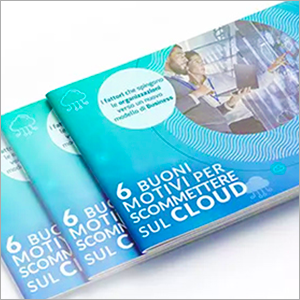
The Cloud is a technology that, thanks to its organizational and implementation flexibility, can offer increasingly faster, more efficient services and solutions that meet the evolving needs of businesses and customers.
This FREE GUIDE aims to dispel myths about the Cloud and, above all, help you understand the best solution for your needs for better management of business processes. Discover upcoming digital scenarios , the advantages of the Cloud , and the types of services useful for businesses .


Data and IT infrastructure security is a critical issue for all organizations. Protecting systems from cyberattacks is essential to maintaining the integrity and continuity of the services provided.
This situation can become particularly critical if the targets of potential cyberattacks are public administrations and/or healthcare systems , with predictable and potentially devastating consequences. Indeed, the interruption of services offered by these organizations or the compromise of even sensitive data can cause serious harm to the community, jeopardizing the safety and health of citizens.
Openwork , which has always invested in this area, has received another important recognition for its Jamio cloud platform , already listed in the National Cybersecurity Agency (ACN) .
Jamio's openwork SaaS service has officially received the QC2 qualification from ACN. This means that Jamio cloud solutions are suitable not only for managing ordinary services, but also for critical ones, the compromise of which could jeopardize the maintenance of functions relevant to society, health, safety, and the economic and social well-being of the country.
What are the levels defined by ACN?
The Agency's model classification model has three levels, based on the identification of the criticality level of services based on the potential effects of their compromise, in terms of availability, confidentiality, and integrity:
In detail:
• Strategic: services whose compromise could have an impact on national security;
• Critical: services whose impairment could lead to damage to the maintenance of functions relevant to society, health, safety and the economic and social well-being of the country;
• Ordinary: services whose impairment does not cause harm to the economic and social well-being of the country.
Critical services include services that process large amounts of personal or health data, essential services provided by NIS Operators at the local level, etc.
Using Jamio is therefore safe for both public administrations and healthcare providers, as well as any other company that needs to manage data and services of extreme importance to their business.