





Editorial by:
Ivan Giuliani
Marketing & Digital Coordinator Openwork
Build your own software without a line of code
The changes of our time have led to a significant acceleration in the needs of small, medium and large organizations. To keep up with the times, they require cutting-edge technological solutions that are in line with the constant changes in the market in order to continue to grow and compete in contexts rich in opportunities but also new challenges in terms of digitalization .
Hence the need for companies to innovate and renew themselves with the help of software capable of automating processes, speeding up and monitoring information exchange, improving collaboration, and, more generally, optimizing the productivity of individuals and the entire organization to keep pace with a market that is now moving at the speed of light.
This need, initially latent, has become increasingly recognized with the advent of the pandemic, especially at the enterprise . However, accelerating software and application development requires high-level professionals, lengthy and costly technical timeframes, and—if you will—also a good dose of luck in finding resources with significant expertise to achieve business objectives in the shortest possible time.
This is no easy task, given that, in the Italian case, "Half of our companies complain of a digital skills gap in the market [...]," says Paola Generali, president of Assintel (National Association of ICT Companies); a statement that stands out even when compared to the recent report by the European Court of Auditors presented in February 2021, which shows that Italy stands out negatively in terms of digital skills , ranking fifth from last compared to other European countries.
IT professionals are therefore , and although we are still far from bridging this gap, new digital technologies are coming to our aid, enabling organizations lacking specialized resources to independently create professional business management applications. We're talking about the technologies offered by No-Code , which, unlike Low-Code platforms, allow software applications to be created without the need for programming language knowledge.
An innovative approach to business application development that obviously saves significant time, as well as reducing risks and headaches thanks to the use of visual languages and conceptual models instead of typical programming codes, allowing any company resource to create professional software applications quickly and without the support of programmers through a "design" associated with behavioral rules.
Example of business process modeling with Jamio , the No-Code platform
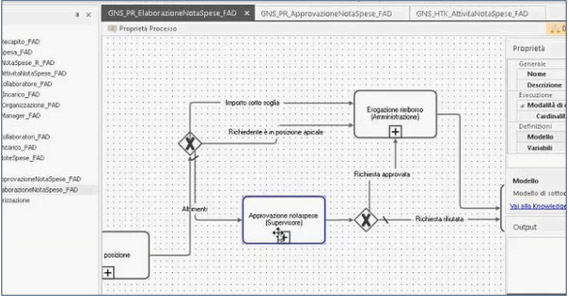
Using graphical tools instead of programming languages mitigates the digital skills gap and empowers a resource to become a designer capable of designing business software exactly as they imagine it in their head (business language), without having to worry about finding external professionals or companies to transform an idea into an application solution.
The No-Code platform offers several benefits:
1) Ease of use
The absence of code allows even non-programmers to create business applications, just like WordPress (one of the most used CMS in the world) which allows users to create websites without knowing web development languages.
2) Solutions ready in just a few days.
Rapid development makes it possible to create software applications usable throughout your organization, with the transition from idea to solution occurring, depending on the case, in just a few days rather than several months as with traditional approaches.
3) Flexibility.
The model-driven approach allows the designer to easily modify the applications created, thus rapidly adapting them to any organizational changes. Therefore, the applications created evolve alongside the company.
4) Affordable costs.
Commissioning a project involves significant costs and lengthy development times; having an in-house no-code platform saves time and investment, but above all, allows you to create an unlimited number of applications at the same cost.
5) Independence
: Allowing an organization to independently create its own business applications frees it from software companies, with benefits in terms of costs and project implementation times. It also allows for the ability to manage needs related to emergencies that require extraordinary interventions very quickly.
6) Rapid Prototyping
No-Code platform modeling tools allow companies to rapidly prototype a business process before actually developing the solution. This allows them to understand aspects well in advance that, in other contexts, would only emerge at the end of the development process, with all the associated inconveniences, and greatly benefits implementation risk reduction.
Further supporting these theses is Forrester's prediction for 2021 regarding software development, which, according to the research firm, will be 75% done by low-code/no-code platforms. also states that "Companies that have adopted low-code/no-code platforms, digital process automation, and collaborative work management have responded more quickly and effectively than companies that rely solely on traditional development."
In the popular imagination, Americans are the leaders in the software sector, but Italy is also doing its part with a no-code platform capable of perfectly responding to the aforementioned benefits and competing with the big global players: we are talking about Jamio openwork.
Jamio 100% Italian application development platform that allows you to create applications for managing business processes without using programming code. It also allows you to take advantage of the Microsoft Azure cloud , an environment where you can securely publish your applications and make them immediately available to the entire organization.
This no-code platform allows you to quickly create and model a multitude of solutions, define behavioral rules, and adapt them to new needs, intervening only where necessary using the modeling tools provided by Jamio.
The No-Code platform represents a breakthrough, allowing developers to build their own software in-house (at the same cost and with no usage limits) and leveraging their internal resources, saving additional funds that could potentially be invested in other prestigious projects for the company's growth.
Finally, there are the benefits related to business development and the future of the company to consider: a platform like Jamio enables the company to rapidly digitize business processes with all the associated advantages, including the ability to be ahead of others in the market with high-performance services that, by increasing customer satisfaction, also lead to improved business.
Editorial by:
Ivan Giuliani
Marketing & Digital Coordinator Openwork
Jamio HARP 4.6 R3 – What's New in Jamio's New Release
New and interesting features, both for Jamio designers and for system integrators ; in addition, the introduction of some document automation and further improvements in terms of user experience .
jBIZ | Business Digitalization According to Jamio:
Using Surveys in Business Processes

A survey , or inquiry, aims to collect information through a questionnaire to discover/investigate the habits, needs, opinions, and requirements of a sample of individuals, often external to the organizational context.
Conducting a survey involves three fundamental steps: preparation, execution, and analysis. Surveys can be conducted for market research, employee or customer satisfaction, marketing, healthcare, education, meeting and event planning, and more.
The ultimate goal of a survey is, in most cases, to make a decision and, in some situations, to follow up with specific actions based on the data collected.
Continue reading from the PDF…
Openwork in the "Puglia on the Move" column.
Video of the TGR RAI Puglia television report.
We aired on RAI3 in the column “La Puglia che va” , a space on TGR RAI PUGLIA dedicated to the Apulian excellences that are distinguishing themselves in the area by taking their offering well beyond the regional borders .
The report produced by RAI talks about Openwork and the technologies developed to help companies automate business processes and quickly manage people, data, documents and events.
Plus, news and future prospects. Watch the report now.