









Jamio lowcode nocode cloud platform
Risk Management with a no-code approach

MAGAZINE N. 52 | Risk Management and the No-Code Approach

Risk management requires Risk Management procedures can be summarized in the three phases of Prevention, Detection, and Response . These three phases cannot be considered static over time, due to the evolving nature of risk situations. Furthermore, although risk analysis methodologies can be adopted that minimize the extent of residual risk, these activities are characterized by predictive and probabilistic elements, so it is reasonable to assume the presence of tacit risk factors. It is reasonable to say that zero risk is unattainable, which is why, in addition to the preventive phases, it is necessary to equip ourselves with methodologies and tools for managing incident responses and enabling the evolution of the response model to unexpected or undetected situations, as per the monitoring plan.

Regardless of the nature of the risk , a risk situation presupposes two phases: that of containing the damage, direct and indirect , determined by the risk situation on the one hand, and the implementation of an evolution of the prevention system , with the aim of reducing the probability of occurrence, adapting the different components of the risk management , the informational, the organizational and the technological ones.

When developing a risk management support system, it is necessary to ensure that comply with the organizational risk management model and that appropriate improvement measures are easily implemented. Furthermore, the model must be designed to be resilient ; therefore, it must not be tied to rigid, predefined processes, but must ensure the flexibility necessary to develop the most appropriate response actions for the given situation.

To achieve this goal, Openwork 's no-code and model-driven approach enables the combination of people, organizations, data, documents and actions in this direction through the use of the Jamio openwork .

Secure Safe Apulia project , carried out in partnership with EXPRIVIA SPA, MAC & NIL SRL, EUSOFT SRL, SYSMAN PROGETTI & SERVIZI SRL, financed under the FSC 2007 - 2013 - Title II - Chapter 1 "Aid for investment programs of large companies", models and methods for the implementation of safety and security management systems have been developed, starting from cyber risk, but extending it to the issues of physical and organizational risk.

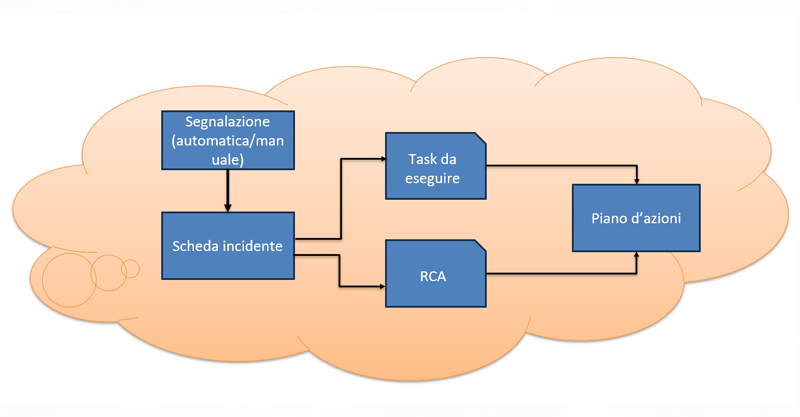
Specifically, Openwork Detection, Response, and Prevention phases Jamio openwork platform, focusing on integrated response and defining patterns for implementing response protocols. This is based on the premise that, within a continuous cycle of security management , prevention and response differ in the timing of specific actions, whether they are performed in advance of an event or activated in response to the manifestation of a risk situation. However, similarities in the execution of the action are maintained. This is particularly true in the predictive risk analysis and audit phases of the causal chain that determined the origin of the damage.

Risk Management BPM nocode platform

Openwork has defined models and methodologies that, in line with the company's mission of enabling organizations to build no-code solutions, enable the achievement of the aforementioned objectives, namely:

  • Compliance with the organizational and procedural model:
    involves activating authorized resources to perform certain actions and access data and information, in relation to the organizational structure set up for risk management, whether it is the same corporate organizational structure or an organizational structure defined specifically for this purpose;

  • Resilience:
    processes and activities are not rigidly orchestrated, but
    • an approach borrowed from case management is implemented, operating in a destructured manner with actions necessary for the specific objective of the contingent case
    • Patterns are used for collaboration and coordination between human resources in achieving a specific objective: with this approach, action plans are defined in response to a specific incident, activating both containment actions and audit actions, which are composed according to the specific need directly during the execution phase.

  • Continuous adaptation:
    Audit activities, through the implementation of RCA, lead to the definition of actions aimed at improving the existing prevention system (for example, by varying the frequency of training and education courses) or even to changes in the system itself (changes to the organizational system, introduction of new structured actions, changes to procedures), which benefits from the no-code, model-driven approach for rapid and seamless changes. The no-code approach makes these interventions more rapid, as it allows business analysts to independently define and implement them.

The defined approach intersects two dimensions. The horizontal dimension is characterized by all those common actions and patterns that are independent of the specific application domain, but involve the collaboration of human resources, coordinated by a manager, in achieving one or more objectives (action plan) or initiating common processes , such as sending communications to entities within the domain or activating external communication flows, either directly through pre-established channels (email, SMS, etc.) or indirectly through social media. The vertical dimension, on the other hand, characterizes the aspects of the specific application domain (fire risk, chemical risk, cyber risk, etc.), such as the distribution of authorizations, organization, documents, types of reports and incidents, available procedures, and contact channels, which can also be managed jointly, outlining a unified framework for corporate safety and

Lowcode workflow nocode platform

The testing activities, conducted in collaboration with Eusoft , which specializes in Chemical Defense , focused on chemical risk. It was necessary to verticalize the patterns defined in incident response models characterized by emergency situations caused by increased chlorine concentrations in a human-inhabited environment. In this context, it is essential to activate evacuation processes within a timely manner to ensure the safety of individuals. In such situations, it is necessary to distinguish false alarms, for example caused by technical problems with sensors, from cyber issues. The proposed solution therefore integrates different organizational models for cyber risk , chemical risk , and technical anomalies based on the signals detected in the environment.

The patterns studied respond to the typical characteristics of the no-code and model-driven approach that underpins Openwork , in which pre-established solutions (patterns) can be specialized and/or expanded in specific domains, but exploiting the concepts studied on a generalized model, in which issues of asset management , incident response , and audit with models for the coordination of activities, with the definition and assignment of action plans within an organizational context.

Risk Management with a no-code approach Jamio
Jamio Openwork Business Case

New Jamio 4.8 release: Release begins in October 2024

Jamio Release 2024

Organizational structure management moves online

With the Jamio Openwork 4.8 release, available from October 2024, important new features will be introduced that will enrich and improve the use of the platform for the benefit of both Jamio designers and end users .

The new feature we'd like to focus on in this article, which opens up interesting new possibilities, is that organizational structure management has moved online; we'll leave the in-depth analysis of the other improvements and features introduced to more technical documents.

The new full web Organization Manager

Jamio Composer authoring tool , currently consisting of an application that runs under a Microsoft Windows environment, will over time be replaced by completely web-based authoring tools .

The first step will start in October: the Organization Manager is the first of these tools that will be “moved” from the current Jamio Composer to a full web editor, available for each individual Jamio workspace, accessed via the Admin Console , the administration console of a Jamio workspace.

So, what will happen, regarding the management of the organizational component , starting from October 10, 2024?

For end users of the solutions , i.e. those who access the workspace via browser or mobile app, nothing will change ! They will be able to continue using Jamio solutions normally and manage users, tasks, and groups, as they are used to doing. Nothing will be different on Jamio on stage! In fact, the change has been designed and implemented in such a way as to have no impact on the thousands of users of Jamio solutions.

Jamio solution administrators , however, by accessing the "organizations" menu item from the Admin Console , will find the organizations published in the workspace, now available for consultation only, fully editable through a graphical editor that allows visual operations, drag & drop, undo/redo, image creation, etc. Organizational units can therefore be added, new organizational positions inserted, hierarchies modified, and much more. In short, the entire life cycle of an organization can be managed from the web, completely autonomously from Jamio Composer .

This prerogative can also be delegated to other users of the solution, appropriately registered in a new platform group called Organization Managers .

In the release following the October one, account management, account policies, and password policies will also move to the Admin Console, with the goal of eventually bringing all other administrative functions, such as group management, there.

Jamio designers also benefit from this by offloading the burden of organizational design when modeling a Jamio solution, as this can no longer be done using Jamio Composer .

But what about existing solutions? Developers won't have to worry about adapting Jamioware , except for a few small adjustments during the new release phase. In fact, the change was designed and implemented to make existing Jamio solutions compatible.

When you open the source code for a solution containing an organizational component in Jamio Composer, it simply won't be displayed. Upgrading Composer automates this process; you may just need to reconcile some aliases that reference organizational components before republishing.

For new solutions , creating the organizational chart for a specific Jamio area will, as previously mentioned, be done online from the Admin Console . This streamlines the procedures for publishing an organizational chart to production, with the ability to create and export publication reports and reports on generated issues. It will be possible to export an organizational chart and import it into another workspace. However, any customizations to any organizational templates will remain in the composer.

What business scenarios are being opened up?

Managing an organization shouldn't be a purely technical issue but must be manageable by business users . This release goes exactly in this direction: it is no longer necessary to access technical tools (Jamio Composer) to manage an organization but it can be done easily from the web administrator and organization manager is introduced in each area .

Furthermore, the versioning of organizations and the modification that occurs in a temporary area , brought to the level of business users, allows for a management of the organizational components that is closer to the Enterprise needs as well as greater peace of mind given the simple possibility of rolling back the maintenance of the organizational components.


Academy Jamio openwork

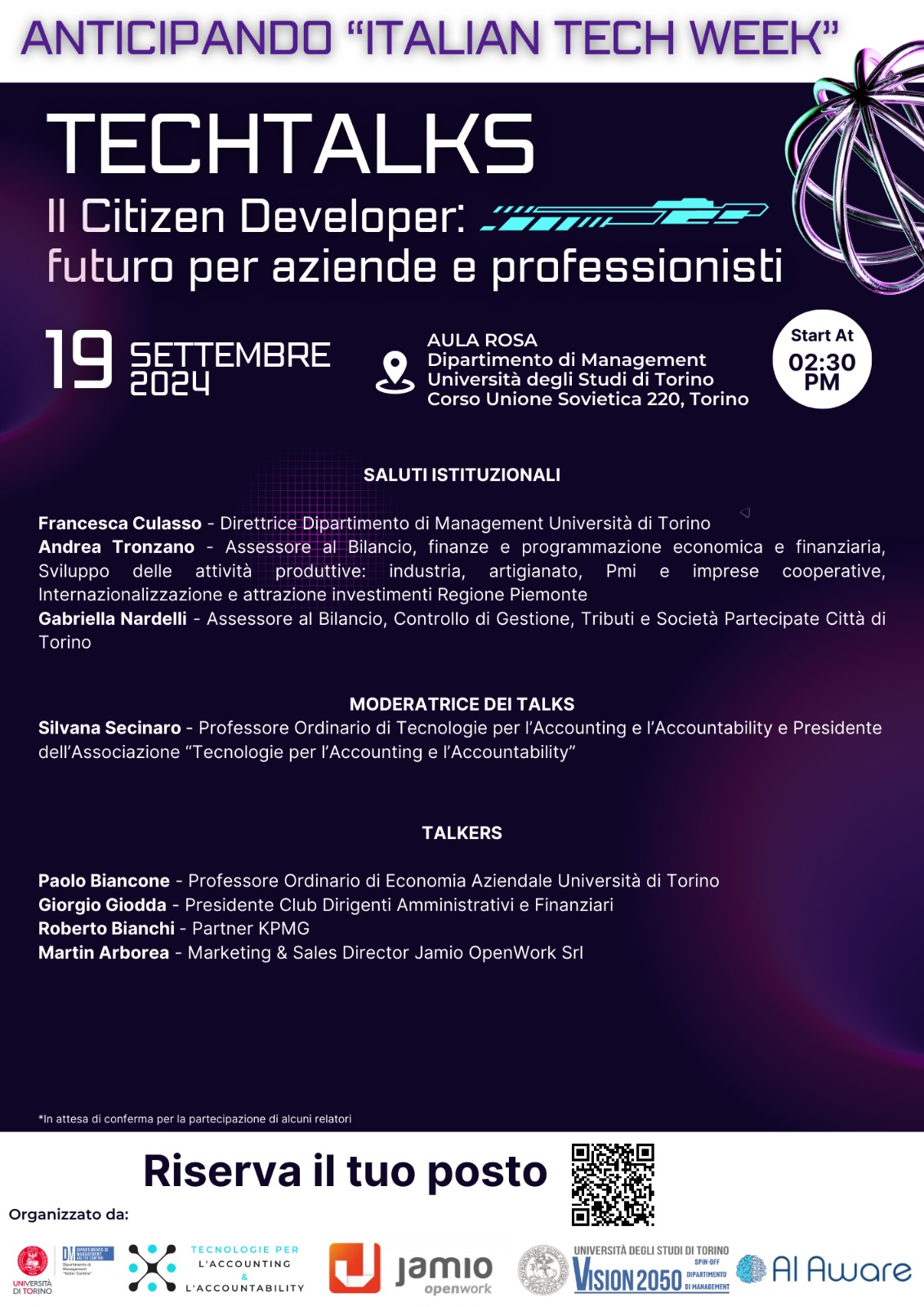
Openwork at the University of Turin's TechTalks: the agenda includes project work by participants in the no-code mini-master's program.

TechTalks UNITO Jamio openwork

On Thursday 19 September at 2:30 pm at the Management Department of the University of Turin,  Jamio openwork will be speaking at the TechTalks “The Citizen Developer: the future for companies and professionals” .

The meeting will also be an opportunity to present the project work carried out by the participants in the Short Master “ New frontiers to bring business and IT closer together: Citizen Developer and no-code application development”, designed and created by UNITO in collaboration with Openwork .

Four working groups, four different business cases drawn from the work or study context, quickly analyzed and modeled into a software solution with the no-code platform Jamio openwork .

There will therefore be an opportunity to give substance to the words by presenting the results of a challenging and innovative journey, which has concluded successfully and which will be proposed again as an opportunity to further qualify in addressing the challenges that the intersection of IT and Business continuously poses in the world of work.

TechTalks UNITO
Jamio Openwork Partner Customers

Industry Digital Evolution 2024: Openwork will be present at the three-day event in Ostuni.

“Building a resilient and sustainable transformation in key sectors to promote international competitiveness”

An important opportunity for discussion and innovation, dedicated to resilient and sustainable transformation in key industrial sectors. This is the seventh conference "Digital Evolution of Industry – IDE 2024 ," a three-day event where experts from leading companies, SMEs, and research centers gathered to discuss and exchange experiences on how new digital solutions are reshaping the global competitive landscape.

The event, held from 4 to 6 September at the Grand Hotel Masseria Santa Lucia, Ostuni (BR) , included 5 thematic sessions that explored the integration of advanced practices to optimize cost and resource management , promoting organizational resilience .

Openwork CEO Salvatore Latronico also took part in the conference, speaking in the session dedicated to Healthcare no-code application development technologies can help clinical research systematically collect, store, and process large amounts of data to prevent the development of neurodegenerative diseases in at-risk individuals.
RELATED BLOGS

Digitizing Beyond Excel with Lowcode Nocode
MAGAZINE N.62 | The false myth of digitalization:

By Martin Arborea For many organizations, "being digital" means using tools like Excel, email, Drive, chat, WhatsApp, and management software.

MAGAZINE N.5 – HOW DOCUMENT MANAGEMENT IS CHANGING.

4 USE CASES The growing amount of documents, bureaucratic procedures and corporate procedures have always made this issue a long-standing and problematic one for a company.