





Editorial by:
Ivan Giuliani
Marketing & Digital Coordinator Openwork
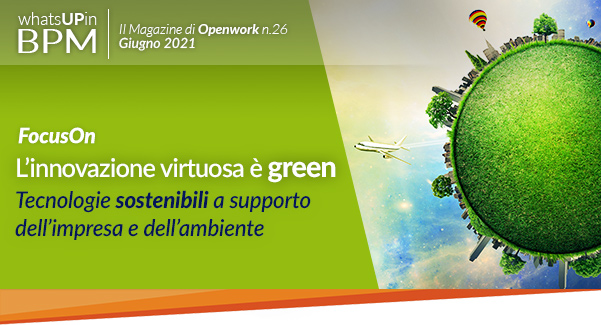
The topic of sustainable development is becoming increasingly relevant in every business activity, especially in the innovation of business models that converge in the digital world.
In fact, with the evolution of industry, the need to produce goods and services on a large scale, combined with the desire for growth and wealth, have put our planet's natural resources, air quality and respect for the environment at risk, all factors threatened also, and above all, by the phenomenon of globalization .
In this delicate and dramatic historical period, companies' strategic choices can prove crucial to the survival of our ecosystem. The 26 European countries , having recently unanimously signed "A Green and Digital Transformation of the EU ," a declaration aimed at accelerating and spreading the use of green digital technologies for the benefit of the environment. Within this framework, 26 CEOs and presidents have decided to commit, on behalf of their respective ICT companies , to drastically reducing carbon emissions by 2030. This alliance, dubbed the "European Green Digital Coalition," includes names such as Microsoft, Ericsson, SAP, Aruba, Vodafone Group, and many others.
These premises follow up on some of the 17 themes already addressed in Agenda 2030 , the action plan for the planet, people and prosperity signed in 2015 by the governments of 193 UN countries and aimed precisely at sustainable development . In this regard, several companies and multinationals have been developing initiatives in recent years to safeguard the health of the planet, as well as the future of future generations thanks to important and ambitious sustainability programs . However, to significantly reduce pollution and the exploitation of non-renewable energy, every company, small or large, must commit to protecting the environment in which it operates.
For example, the digital transformation of companies , which has been greatly promoted and desired especially in the last decade, has led to the creation and evolution of several technologies that respond in an exemplary manner to environmental sustainability, making it possible to launch, almost jointly and globally, important forms of innovation that on the one hand increase the proactivity and productivity of companies and on the other give an eye to the environment; in a simple word, innovation goes green .
It is essentially a virtuous form of innovation that allows organizations to benefit from digital services without negatively impacting the earth's natural resources through energy surpluses or polluting emissions . This enables the company to become an exemplary model for society and the businesses of the future.
The digitalization and automation of processes , a very popular topic especially at the enterprise , is an example of a need that requires technologies capable of perfectly marrying both corporate logic and eco-sustainability , restoring competitiveness to the company and revitalizing the planet's natural resources. We are talking about Business Process Management cloud technologies: designed to manage and automate business processes , they enable large organizations to achieve a digital transformation that is both effective for business and sustainable for the environment .
While the digitalization of companies already in itself leads to a drastic reduction in the exploitation of precious resources (such as deforestation for paper production), the use of specific cloud technologies can generate a multitude of other benefits for environmental sustainability.
According to an independent study by the Lawrence Berkeley National Laboratory, in fact, the use of a cloud system reduces the energy consumption of information technology by 87%. In this regard, we cannot fail to mention the example of Azure Microsoft 's cloud infrastructure that uses renewable energy while maintaining its performance intact and reducing its impact on the environment thanks to effective and efficient equipment.
This is an aspect that should not be underestimated, given that the energy consumption of traditional data centers and the resulting polluting emissions are issues that have been known and detected for some time, as demonstrated in 2017 by the European Commission when, analyzing the IT sector, it observed that Internet Data Centers generated up to 2% of global CO2 emissions .

Another advantage of cloud technologies undoubtedly concerns the ability to enable company employees to work , as well as a further reduction in CO2 emissions due to the drastic reduction in car travel. This added value is also documented by a study by the Smart Working Observatory of the Milan Polytechnic, which demonstrated that each employee who worked remotely for an average of 2.7 days a week (during the pandemic year) individually saved 1,861 kg of CO2 in carbon emissions.
Even the simple use of certified email (PEC) benefits the environment. An IDC report, sponsored by Aruba, InfoCert, and Trust Technologies, found that even using certified email (PEC) saved approximately 78,000 tons of CO2 in 2019 alone, as well as preventing citizens from traveling approximately 253 million kilometers.
In light of these promising and interesting data, the question is: is there a cloud platform capable of managing the entire corporate ecosystem of data, documents, processes, and communications without impacting the environment?
One platform that perfectly meets the above requirements could be Jamio , the cloud-based business process management that enables businesses to transform into virtuous and exemplary organizations not only because of the benefits generated by digitalization but also because the organization, in carrying out its functions, does not generate negative impacts on the atmosphere thanks to Microsoft Azure , the cloud on which Jamio is based. By using renewable energy sources, the cloud reduces consumption and air pollutants.
Therefore, the platform generates four environmental benefits:
1) Energy saving
2) Reduction of the use of non-renewable natural resources
3) Reduction of polluting emissions
4) Saving on paper and safeguarding trees and nature
Four good reasons to choose Jamio which, combined with business process automation , can transform an organization into a more productive, innovative and competitive company, the right mix to face the challenges of the future with intelligence and a pinch of generosity.
So, the conditions and solutions for environmentally friendly innovation exist and have begun to spread far and wide. Now, however, it's up to each company to seize these opportunities to grow their business while keeping an eye on the health of our planet.
Will this be the real challenge of innovation ?
Editorial by:
Ivan Giuliani
Marketing & Digital Coordinator Openwork
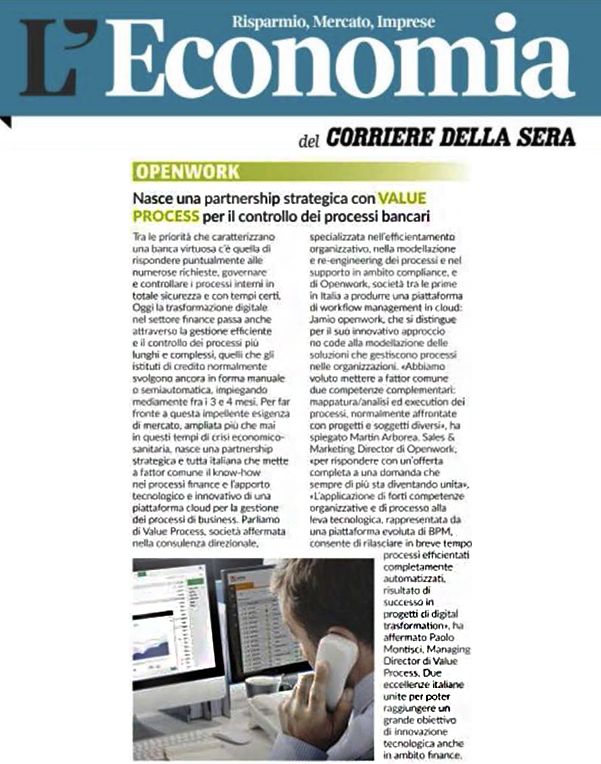
Openwork & Value Process in the Corriere della Sera weekly.
The press release

Value Process and Openwork have formed a strategic, all-Italian partnership to improve operational efficiency and secure banking process governance.
Among the priorities that characterize a virtuous bank is responding promptly to numerous requests, managing and controlling internal processes with complete security and within defined timeframes.
Today, digital transformation in the finance sector also involves the efficient management and control of lengthier and more complex processes, those that credit institutions typically still carry out manually or semi-automatically, taking an average of 3 to 4 months.
To address this pressing market need, which has grown more acute than ever during this time of economic and health crisis, a strategic, all-Italian partnership has been formed, combining expertise in finance processes with the technological and innovative contribution of a cloud platform for business process management.
We're talking about Value Process – an established management consulting firm specializing in organizational efficiency, process modeling and re-engineering, and compliance support – and Openwork , one of the first companies in Italy to produce a cloud-based workflow management platform: Jamio openwork , which stands out for its innovative "no code" approach to modeling solutions that manage organizational processes.
" We wanted to combine two complementary skills: mapping/analysis and process execution, normally addressed by different projects and stakeholders ," explained Martin Arborea, Sales & Marketing Director at Openwork , " to respond with a single offering to an increasingly unified demand ."
"The application of strong organizational and process skills to the technological lever represented by an advanced BPM platform," explained Paolo Montisci, Managing Director of Value Process , "allows us to quickly deploy fully automated, streamlined processes, a successful outcome in digital transformation projects."
Italian excellences united to achieve a major technological innovation goal, including in the finance sector.
Jamio and the no-code development community
 Openwork constantly works to promote the values of innovation and business sustainability, including through its closeness to its community, bringing its innovative no-code approach.
Jamio 's profile on NoCode Italia , the Italian reference for no-code development.
jTECH | Application development using Jamio
Define a deadline for processing a document using scheduling

Let's learn how to set a deadline for processing a document associated with a personal data sheet using an example Jamioware called: GestioneSchedulazioni
This Jamioware allows you to define a single pre-expiry, expiry, and post-expiry schedule for each document in order to:
– monitor the final date for processing the document;
– act promptly to obtain the updated document.
Not only that, we can pause a schedule or alternatively delete an existing one.
To achieve this, we'll learn how to call and use the methods of the Jamio Schedule .