





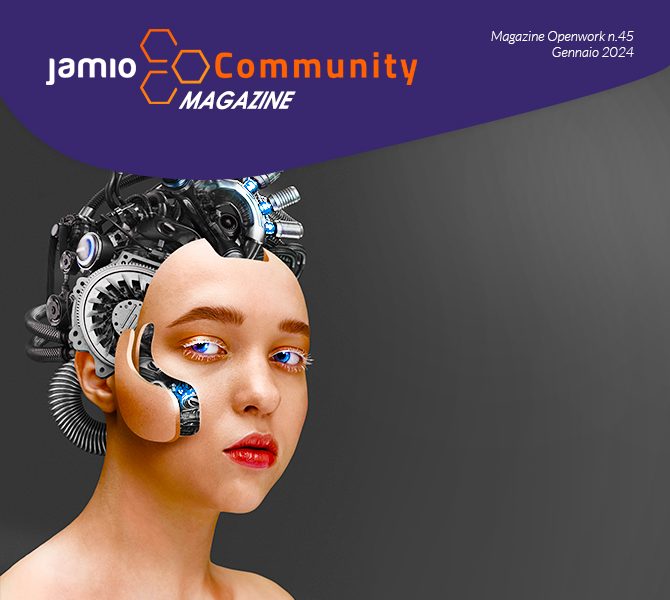

2023 was certainly the year in which AI went from being a topic for insiders and a long-standing behind-the-scenes issue to a topic of public domain.
The widespread use of generative AI (GAI) by the general public has prompted a multitude of questions regarding its impact on the future of work.
One of the activities that is certainly impacted by the use of GAI is software development , and therefore many wonder whether software developers will be necessary in the future.
To answer this question, it's important to clarify that an enterprise software application is n't a mere fragment of code, but rather a set of software components designed, implemented, and orchestrated to meet a specific business need. The development and use of a software application can encounter a variety of functional, efficiency, usability, security, and compliance issues that only a critical and creative approach, typical of human action, can resolve.
Developers will therefore remain essential in software development : GAI will help streamline and automate some activities in the software development cycle.
And could low-code/no-code (LC/NC) cloud platforms one day be supplanted by GAI?
Interesting is the answer provided by ChatGPT itself to the question "Can generative AI supplant LC/NC development platforms?". The answer is below.
GAI and LC/NC platforms serve different purposes and can coexist, but one is unlikely to completely replace the other. Let's look at some considerations:
- Complementarity : GAI could be used to enhance the capabilities of LC/NC platforms. For example, AI could assist in automatically generating code based on specific requirements, further reducing the amount of code developers need to write manually.
- Project Complexity : For more complex and specialized projects, the expertise of more experienced developers may still be required. LC/NC platforms are often optimal for simpler, more standard projects, while generative AI may not cover all the nuances of more complex projects.
- Customization and Flexibility: LC/NC platforms are designed to be accessible to non-developers, allowing them to quickly create applications. However, generative AI may not be as flexible or customizable, especially when it comes to meeting specific business needs.
- Continuous Learning : GAI could benefit from continuous learning to improve its capabilities over time. However, LC/NC platforms are more user-directed and controlled, allowing for greater control over application evolution without relying on machine learning processes.
- Data and Business Process Integration : LC/NC platforms often focus on ease of data and business process integration. Generative AI may require more effort to achieve a similar level of integration without human intervention.
In conclusion, while GAI and LC/NC platforms can collaborate and influence each other, it seems unlikely that one will completely replace the other. The choice between the two will depend on the specific requirements of the project, the complexity of the application, and the desired level of control and customization. We will likely see increasing integration of AI technologies within LC/NC platforms to enhance their functionality and streamline application development.

Ultimately, both technologies aim to simplify application development, but they serve distinct use cases and target different types of users. More specifically:
GAI
- The GAI, like GPT-3 and similar models, is primarily designed for generate text or contents similar to humans based on input data or prompts.
- It can assist developers by generating code fragments, providing explanations in natural language or automating text generation tasks.
- The GAI is a tool that developers and subject matter experts can use to simplify certain aspects of their work , such as documentation or assistance in writing code .
LC/NC platforms
- LC/NC platforms are designed to simplify the development process of complete software applications, providing visual interfaces, drag-and-drop components, and pre-built templates.
- They are intended for users with different levels of technical expertise, including business analysts And citizen developer.
- They aim to reduce the need for hand coding and accelerate the development of applications for a wider audience of users.
- A platform is an environment that, in addition to allowing the writing of the software application, allows it to be executed while guaranteeing resilience , efficiency , disaster recovery , security , compliance . It is a service in which the functional component is only one part of the entire service offered.
It is therefore unlikely that GAI will replace LC/NC platforms. Both technologies have their place in the software development landscape . Rather, GAI represents a great opportunity for LC/NC platform manufacturers to further enhance the role of the citizen developer . In fact, GAI can simplify those application "writing" activities that still require coding skills (scripting, rule writing, etc.) and automatically compose, based on business needs, application prototypes from which to start developing the application to be sent to production.
Ultimately, GAI and LC/NC platforms are two powerful tools that, when integrated, will make software development even more efficient.


CASE 1 – Extending processes outside your organization
We have already introduced the topic of extended or inter-company , that is, those processes that extend beyond the boundaries of the organization (magazine n°43).
These processes, we recall, can include collaboration and information exchange between companies or entities to create value for all involved. We can identify them, for example, in supply chain management involving suppliers , but also in customer relationship management, commercial partnerships ( with partners or agents), intercompany collaboration , shared logistics , project coordination recruiting activities .
Effective management of these processes is achieved by using appropriate tools that allow you to govern and monitor the entire business flow, avoiding multiple systems and information redundancy.
We've previously discussed the quote management customer request management use case, where the external stakeholders are customers and external consultants working on behalf of that organization.

CASE 2 – Customer Request Management
Company areas involved: transversal to the areas
Organizational needs
We work in an accounting firm, and in this field, as in many other contexts, clients often have to submit numerous requests to consultants , from requests for documentation to the processing of various procedures. Some of these requests have specific processing times their processing is generally to a specific consultant , depending on the area or the client's expertise .
Furthermore, some types of requests require the signing of a specific contract with the client, while others can be processed directly, based on a general contract already signed by the client. Even consultants, not being employees of the firm, may require a specific contract to be hired for a specific case.
The most commonly used way to manage this process is highly unstructured and can be traced back to the following main activities:
- The client contacts the firm either by email or by telephone, formulating the request in his own language;
- Someone takes care of collecting the request , evaluating it and sending it via email to the consultant ;
- If necessary, someone takes care of: drafting and having the client sign a contract and/or drafting and having the consultant sign a contract.
- The hired consultant must respond to the request within certain indicated timeframes ;
- The customer should receive the outcome of his request only once the processing is complete.
Clients participate indirectly in the flow and have absolutely free to their engagement , just as consultants are engaged simply via email. The assignment of cases occurs without any organic vision .
It is easy to see how unstructured management of this type of process can lead to various problems, negatively impacting overall efficiency and effectiveness, with direct repercussions on customer satisfaction :
- Disorganization and misunderstanding: Customer requests may be handled in a disorganized manner, making it difficult to interpret, track, and resolve them in a timely manner;
- Risks of loss: There is a risk that requests will be lost or overlooked, resulting in customer dissatisfaction and lost business opportunities;
- Ineffective resource allocation: It may be difficult to effectively allocate the human and time resources needed to handle customer requests, leading to delays and poor service quality;
- Difficulty finding and processing documents: It may be complicated or expensive to search for or share customer documents and data;
- Difficulty in monitoring: Lack of adequate tracking can complicate monitoring request status and overall process performance, making it difficult to identify areas requiring improvement.
The solution
process and document automation tool like Jamio, an organization can streamline the management of customer requests, increasing customer satisfaction and its reputation.
The flow described above becomes the following.
- The client contacts the firm through a structured form that guides them through the request or by telephone by formulating the request in their own language and someone (even a bot) takes care of reporting the request in the form;
- The system automatically assigns the request to the appropriate consultant. Alternatively, if the request is of a specific nature, someone will evaluate it and forward it to the consultant via the system.
- The consultant receives an automatic email for the engagement ,
- The customer receives an automatic email notification that the order has been accepted;
- Where necessary, the system automatically composes , sends and possibly also collects contracts for engagement with the client and/or the consultant and manages the processing only after the appropriate contractual documentation has been collected ;
- The hired consultant automatically receives information on processing times , indicates the actual times and always deposits the result of his work in the system;
- The customer receives the outcome of his request via an automatic notification email with a link to the system where he can always consult the results of his requests;
- Any intermediate discussions between the client and the consultant are always managed in a traceable manner.
It is clear that all those human activities that involve a waste of time and margins of error delegated to an IT system , such as collecting requests, compiling contracts starting from predefined templates, sending emails, sorting activities based on a classification of requests or a client management consultant.
Furthermore, the participation in the process by external actors, customers and consultants, becomes active , since the customer inputs his request in a guided manner, the consultant carries out the engagement in a guided manner through the system.
Below is a list of action points:
- Request Centralization: All customer requests are collected in a centralized system. Customers can enter requests directly through a guided system, or they can be entered by an operator or a bot following a phone call. This helps keep track of all requests in one place.
- Request Classification: Requests are classified based on the type of consultation requested. This facilitates the efficient distribution of requests to the most suitable consultants, avoiding wasted time.
- Automatic or manual assignment: The system can automatically assign requests to consultants based on their skills, or a manager can manually assign them.
- Status Tracking: Each request is automatically tracked, with the ability to monitor the fulfillment process. This helps keep customers informed about the status of their requests and significantly improves the organization's image.
- Request Priority: Requests can have different priority levels based on their nature and urgency.
- Customer communication: An automatic notification system keeps customers informed of the progress of their requests.
- Information Storage: All relevant information related to customer inquiries is stored so that it can be easily retrieved in the future for review, analysis, or to respond to similar inquiries.
- Security and confidentiality: The system guarantees the security and confidentiality of information starting from secure access.
- Reporting and Analytics: A reporting system could be implemented to analyze process performance, identify trends, and make informed decisions to improve overall efficiency.
The advantages
- reduction of management times
- error reduction
- process control
- elevation of the customer's branding reputation
- Instant sharing of data and documents
- Employment of operators in higher value-added activities
- Organizational efficiency


The new Jamio basic course is currently being developed, continuing Openwork's commitment to making no-code technology accessible and intuitive for anyone who wants to bring their digital ideas to life, regardless of their background.
Vision and Creation
More than just an introduction to no-code with a clear vision: whether you're an entrepreneur, a creative, or simply a tech enthusiast, the Jamio course is designed to open the doors to a world of creative possibilities by breaking down the technical barriers that made software development a pursuit reserved for professional programmers only.
While the course is still being finalized, the foundation is being laid to provide a practical and interactive learning approach. With new content, midterm tests, and exercises, participants will be immersed in an environment where they can experiment directly with no-code tools , gaining not only knowledge but also confidence in their ability to build innovative digital solutions. The new basic course will aim to provide a comprehensive understanding of how to best leverage the Jamio to create innovative digital solutions .
Stay tuned!
With this new approach, the Jamio Basic Course will represent a better learning opportunity aimed at taking a further step towards the democratization of software development.


Openwork technologies always focused on a strategic approach to defining and optimizing business processes through visual languages in place of programming languages (no-code approach) . Shortly after the launch of the Jamio openwork BPM platform Aruba's Cloud Server became evident .
Several years have passed since the migration of some Jamio platform services to Aruba's Virtual Private Cloud. Thanks to its ability to remain perfectly aligned with Openwork's needs, Aruba Enterprise by continuing to provide certainty not only in terms of functionality but also from a strategic perspective, therefore, linked to the certifications required by various Jamio customers (for example, public administrations) for compliance with specific regulations.
All this has been explained in detail on enterprise.aruba.it through a case study dedicated to Openwork , its Jamio and the certified services of its technological partner Aruba Enterprise , an in-depth analysis made possible thanks also to the valuable collaboration of Alessandro Cortese, IT & Devops Director of Openwork .