








In the dynamic and increasingly digital context of companies in the Energy & Utilities , the adoption of Certified Electronic Mail (PEC) remains a fundamental tool for ensuring secure communication that complies with current regulations and standards .
Companies operating in this sector face a unique set of challenges, including the need to maintain high standards of information security, manage significant volumes of communications and paperwork, and interact with a vast network of stakeholders , including regulators and customers.
There's no room for error or inefficiency ; everything must be managed with the utmost rigor. Therefore, there's a need for appropriate tools to support certified email communications management, streamlining operational processes , ensuring their execution , and improving overall business efficiency . In this context, we explore the vital importance of these tools and how they can contribute to the success of companies in the Energy & Utilities sector.
ORGANIZATIONAL NEEDS
Companies in the Energy & Utilities sector make extensive use of certified email communications to interact with a wide range of stakeholders, including Regulatory Authorities such as ARERA , Integrated Information Systems ( SII ), distributors , suppliers , customers and other players in the supply chain.
This widespread use of certified email (PEC) is essential, as well as regulated by communication standards (including Resolution No. 294/06 of 18 December 2006, as amended, "Provisions of the Authority for Electricity and Gas on Communication Standards"), to activate or manage various flows in the sector. It is part of a context in which information exchange occurs through different paths and channels, resulting in fragmented and costly communication in terms of manual and mechanical activities.
Multiple company areas , such as the commercial, technical, administrative, legal, tax, customer service, HR offices, etc., and dozens and dozens of operators interact daily via PEC with a variety of interlocutors for a wide range of flows .
Managing legally relevant notifications and communications (expiration notices, regulatory violation notices, data transmissions), orders, service suspensions, payment reminders, default notices... each communication flow must be managed with extreme precision to ensure that information is transmitted or received effectively and that necessary actions taken promptly .
What would happen if an important communication from ARERA didn't arrive because the provider's space was full and it was no longer receiving certified emails?
And what if the communication, even though it arrives, gets lost on someone's desk and isn't processed or reaches the right person in unsustainable times?
Added to this are hours and hours of work spent periodically sending payment reminders to customers or downloading certified email receipts to attach to a request...
Furthermore, although the SII is optimizing some communication flows, massive communications to be managed via certified email (PEC). Managing them manually is unthinkable, and the only option is to implement very expensive and complex custom procedures.
These are just examples, illustrating some of the many typical scenarios involving certified email (PEC) in an Energy & Utilities company . We are certainly in a complex organizational context, where it is necessary to consider the effectiveness and efficiency of the certified email communication process, risk reduction, compliance, and integration with management software.
Below is a non-exhaustive list of objectives that an Energy & Utilities company certified email communications .
The first objective we set ourselves is undoubtedly the reduction of risk , that is:
- avoid the risk of not receiving and sending certified emails due to filling the provider's mailbox
- avoid the risk of losing certified emails and receipts
- avoid the risk of PECs not being processed or not processed on time
However, in terms of effectiveness and efficiency of the process it is certainly useful:
- message sorting times
- ensure that the certified email has been sent to the correct internal recipient
- be sure that the PEC has been processed
- simple and massive communications with rigor and speed
- streamline operations and avoid wasting time reconciling and printing receipts
- facilitate back office flows, for example for checking and signing incoming contracts
- centralize mailbox management
- monitor the status and processing times of a PEC
- integrate with an ERP especially in cases of mass and/or periodic shipments
security , privacy and access to mailboxes should not be overlooked .
In this scenario, managing certified email (PEC) with traditional tools is not a winning solution and can lead to inefficiencies and represent a risk and cost that a company in this sector cannot afford.
THE SOLUTION
To address these challenges, companies in the Energy & Utilities sector must rely on advanced certified email (PEC) communication management software solutions that can manage the entire communication lifecycle process logic and enterprise-level features. These tools not only streamline operational flows but also offer a series of tangible benefits that contribute to business success.
Jamio openwork is a platform that offers solutions to these needs, already chosen by both distributors and suppliers in the industry. Thanks to its Plug Message , which allows connection to certified email providers, it is possible to configure application solutions that manage the entire lifecycle of certified email communication, orchestrating activities between different stakeholders, managing timelines, automating the sending of certain communications, and achieving a decoupling between people, certified email inboxes, and the information exchanged. People leave, information stays!
The solution, by managing one or more email inboxes, even those from different providers, centralizes the various certified emails in a single location accessible in a profiled by the various operators, simultaneously clears the provider's space and automates or makes the sending and receiving of certified emails more efficient.
Upon incoming calls , it automatically sorts certified emails based on pre-configured rules to a person, office, or role, and oversees the processing cycle from acceptance to completion.
People are asked to process a certified email through a task contained in a virtual activity calendar, which displays only the activities on the messages that need to be processed.
Through the use of a Dashboard , you can consult all incoming messages for which you are authorized, and have an overview of the sorting of all communications and their processing status as well as consult the processing history .
The use of automatic alerts and escalations speeds up work and monitors processing times.
On the outgoing side, you can have fully automated systems that reconcile receipts with sent messages and monitor shipment status.
We also manage mass sending , both simple , where it is sufficient to send the same communication to many interlocutors, and complex , such as sending a payment reminder, where the communication is different for each interlocutor but the processing is carried out on a mass basis by the operators.
We summarize the main features below:
- automatic emptying of the provider's certified email boxes;
- Automatic sorting of certified emails to the appropriate persons and manual sorting
- monitoring of the receipt and processing of certified emails and tracking of times and performers;
- Receipt reconciliation with the sent certified email and the ability to print both the message and receipts in a single action.
- Tracking shipments
- Management of the mass sending of large flows of communications, including document automation and ERP integration
- Centralization of mailboxes and profiled accesses
THE ADVANTAGES
Jamio PEC solutions not only achieve the objectives of effectiveness, efficiency, risk reduction , compliance , and integration no-code Business Process Management (BPM) platform .
This means these solutions have extremely short go-live times and remarkable speed and flexibility in adapting to changes and implementing additional features or business processes that may emerge over time. Thanks to the no-code nature of the Jamio platform, companies can quickly customize certified email solutions to their needs without having to rely on complex and costly software development. This flexibility and agility allow companies to remain competitive and responsive in the dynamic and ever-changing energy and utilities environment.
In conclusion, adopting advanced tools for managing certified email communications, preferably code-free, represents a fundamental step for companies in the Energy & Utilities sector wishing to maintain high standards of operational efficiency, regulatory compliance, and information security. Investing in these tools is crucial to remaining competitive in an increasingly complex and dynamic market.
A no-code short master's program at the University of Turin.
Starting in May.

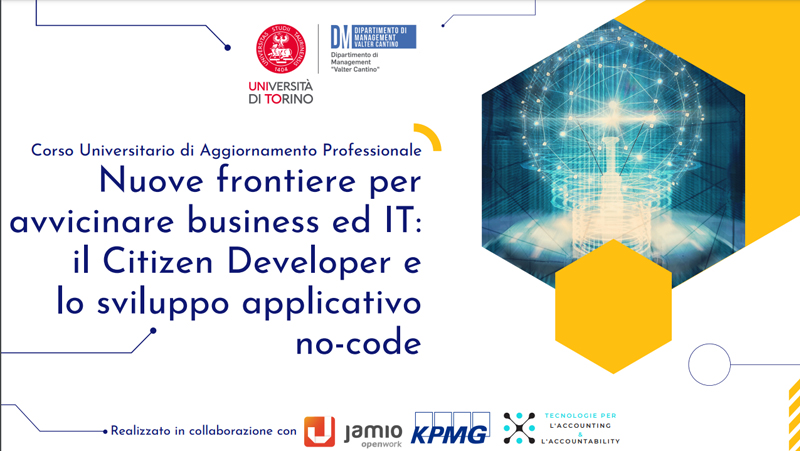
As announced a few months ago, the University of Turin has included in its program for the 2023-24 academic year a Professional Development University Course entitled “New frontiers for bridging business and IT: Citizen Developer and no-code application development” .
low-code and no-code application development platforms , in fact, leading to the emergence of new and diverse professional figures who, without specific programming skills, can develop enterprise-class software solutions.
For this reason, the Management Department of the University of Turin has promoted a short master's degree designed in collaboration with Jamio openwork , KPMG and the Association of Accounting and Accountability Technologies. The program will target young undergraduates, master's students and ITS graduates, all with the aim of training and officially certifying the emerging figure of the "Citizen Developer".
The short master , lasting 125 hours , with 40 hours of online lessons and 85 of offline content , includes topics ranging from general knowledge on the digitalisation of business processes to the importance of correct data management, up to the actual modelling of organisations and processes through the use of low-code/no-code platforms.
Jamio openwork Italian no-code application development platform and partner of the university project, will be the tool through which students will learn to develop business applications without knowledge of programming languages.
REGISTRATION OPENS AND COURSE STARTS
Pre -registrations are open from Monday, February 26th to Friday, April 19th .
For more information, please follow the .
Registration will then open from Monday, April 22nd to Friday, May 3rd . The short master's program will begin on Monday, May 6th with the first online lesson.
Key4Biz discusses the synergy between Jamio OpenWork and Aruba Enterprise

Openwork technologies always focused on a strategic approach to defining and optimizing business processes through visual languages in place of programming languages (no-code approach) . Shortly after the launch of the Jamio openwork BPM platform Aruba's Cloud Server became evident .
The fruitful collaboration with Aruba SpA, therefore, guarantees maximum stability and security for the Jamio openwork platform. Key4biz, the Italian newspaper on the digital economy and future culture, also covered the project, focusing on the Internet, Media, Cybersecurity, Telecoms, Smart Cities, Energy, Artificial Intelligence, Blockchain, Robots, and Games. Alessandro Cortese, IT Director at Openwork, to support the case study .

Alberto Magnani, Business Analyst at Amada Italia, talks about Jamio Openwork.
Alberto Magnani , Business Analyst at the leading company in the sheet metal working machinery sector, explains the reasons that led the company to focus on Jamio openwork to reorganize its business flows.