



A brief account of the Jamio Community Day held in Bari on June 9, 2023.
Technological advances in recent years have opened up new possibilities in software development, significantly simplifying the application creation and reducing the need for programming languages. This trend has prompted the ICT and management consulting industries to question the future and focus on a topic of great interest: developing business applications using low-code and no-code approaches.
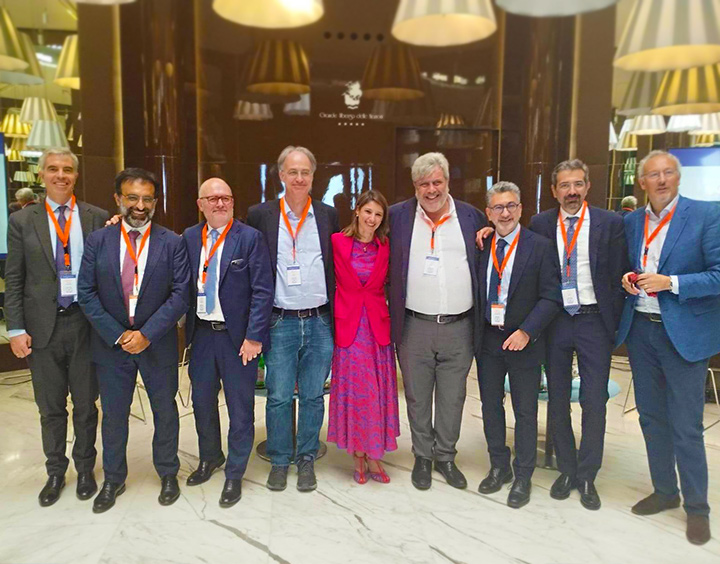
“The community is the place where results are achieved together” , with these words Maria Soave opened the first edition of the Jamio Community Day held in Bari on 9 June 2023 and immediately got into full swing thanks to the Keynote by Giovanni Vanini , Director of the Automation division of PwC Italy .
Since 2017, PwC Italy has established an Automation group that currently spans various application domains and studies and uses various technologies, focusing on the low-code/no-code phenomenon . To understand how and where to use these technologies, PwC conducted a survey of over 4,500 CEOs worldwide:
We are now entering the third generation of automation tools and we are talking about the Digital Fabric , or technologies that, like a connective tissue, allow us to connect different information systems to reduce manual work and inefficiency.
Today's business environments are characterized by the presence of numerous information systems, and business often requires IT to integrate the various systems quickly and with simple, versatile tools: the requirement is not just the automation of single tasks but also "end-to-end process discovery and redesign" .
Analysts say that by 2030, 70% of software solutions will be built using low-code and no-code platforms . But how can we classify these technologies?
"Where will the future take us?" We will certainly need to focus on simplifying information systems: usability, user-friendly interfaces, and rapid implementation .
Low-code and no-code technologies therefore become ideal assets and are also the most suitable for bringing artificial intelligence into organizational processes.
The full slides from PwC's presentation are available here:
After PwC's intervention, a round table discussion began, attended by five leading figures in the use of low-code/no-code approaches.
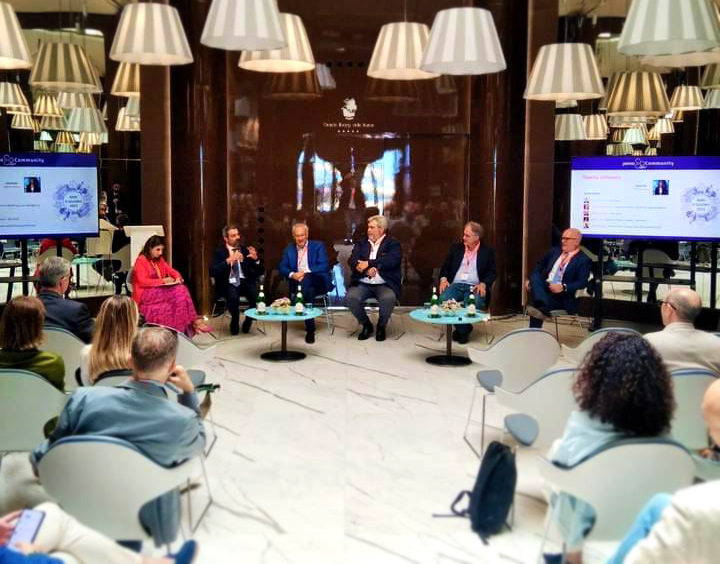
"Why did you choose low-code and no-code technologies for your companies?"
This is how Maria Soave kicked off the round table discussion by giving the floor to Ilario Benetti , CEO of Apex.
An Openwork partner for about 20 years, Apex is an ICT consulting firm that works with major international brands. Ilario Benetti emphasized that "the adoption of these technologies was motivated not only by their novelty and innovation, but also by their ability to meet user needs more nimbly and precisely than traditional solutions."
"Without this technology, part of our business would not have been possible." This is the response of Cristiano Iollo, CEO of Unica spa, a company specializing in energy efficiency and the resale of electricity and gas.
Aldia is a rapidly growing social cooperative that offers various social services through nurseries, retirement homes, and other facilities, working with public bodies.
"Being super agile while being rigorous, or being flexible in rigor," Marco Re 's speech highlighted how the flexibility and agility offered by low-code and no-code technologies have made it possible to meet the changing management needs of a rapidly growing social cooperative.
Massimo Appiotti, Partner at Oxygy, also returns to the topic of speed "In the last 75 years, there have been many more technological innovations than in the previous 2,000 years." It's necessary to look at the world and keep pace with its pace to be competitive in the market. We've chosen to approach the our clients' business processes low-code and no-code technologies, both for their rapid implementation and because they allow us to create a software solution that fully meets the client's requirements.
Silvio Totaro responded by saying he had begun a process with Openwork to address process automation and digitalization using low-code/no-code methods after finding it to be the best possible approach to solving his clients' organizational problems.
After a discussion on the importance of training and the opportunities that being part of a collaborative community offers, the focus shifted to the future prospects that low-code / no-code approaches open up:
Aldia
aims to train internal staff to gain autonomy in the digitalization of many other internal processes;
Unica
sees in low-code and no-code approaches the possibility of easily creating digital solutions capable of connecting processes and users with the prospect of creating a global energy community;
Oxygy
emphasized that " the future already exists," and that today a company cannot fail to conceive of itself as digital. Thanks to the flexibility of available tools, even SMEs can seek business-oriented digital solutions by involving customers, partners, and suppliers in their processes;
Apex
sees the future as a future that is inseparable from digitalization and governance. Many solutions today are still manual, and low-code and no-code technologies can accelerate and influence the growth of all businesses, from the smallest to the largest.
Experis
expressed the need for the ICT world to change its governance model. Technology must always be supported by governance, where rigor and simplicity must go hand in hand.
The discussion concludes with a speech by Openwork CEO Salvatore Latronico : " Our aim is to be a strong testament to the importance of these technologies and how they will revolutionize the business landscape . The Jamio platform was born with an idea: to enable not only process automation, but also the development of fully digital solutions for the enterprise, through a no-code approach. And Openwork has the ambition to become a leading Italian operator that can compete on the market even with large vendors . But this ambitious goal, supported by the numerous investments made and which will bring tangible results starting in 2024, cannot be achieved alone: we can only grow and achieve it together with our partners and customers: this is why we will increasingly push to make our network a community."
Finally, Martin Arborea, Sales & Marketing Director of Openwork, announces that Jamio Community Day will become an annual format. It will be a time for the Community, guided throughout the year by a systematic process, to meet in person to review trends and the market, share best practices, initiate and/or strengthen collaborations, and gather and implement proposals for the Community's growth.