









Edited by Martin Arborea
Business Intelligence allows you to "transform" raw data into actionable information for decision-making. By allowing you to navigate numbers, you can understand their meaning and identify hidden signals, allowing you to react quickly. A true shift in perspective: from simple monitoring to informed and timely action.
Until a few years ago, this type of analysis was carried out using reports available in long paper documents and/or static Excel spreadsheets that almost always referred to out-of-date "data."
Today, by combining tools like Microsoft Power BI and a process management platform like Jamio openwork , you can create interactive and dynamic dashboards, updated in real time with information from your running processes. Information becomes a true asset, always available and contextualized.
And this allows you to make quick and informed decisions that can make the difference between staying competitive or losing ground.
And this is why more and more organizations have made the strategic choice to equip themselves with an operating model that combines process automation and data analysis in a single integrated system.
Many companies are automating by adopting no-code or low-code platforms to model their business processes. Their goal is to standardize, streamline, and make traceable activities that were previously dispersed between emails, Excel spreadsheets, or disconnected management systems . But to unlock the true value—to start making talk and generating structured data that we can collect, analyze, and interpret—we need to integrate Business Intelligence tools.
It's interesting to consider that there are two macro-types of data that can feed dashboards: the first is data specific to the business case being managed. For example, if I've automated a process for issuing offers, I'll have all the data related to the sales pipeline and related activities at my disposal. But at the same time, every digitized process leaves behind traces: a flow of data that tells how the organization moves to carry out the planned steps in that process . So, as I work on the specific data, other data is automatically collected, allowing me to answer questions like these: Where are the bottlenecks? What are the average response times? Which team performs better? And all of this can lead to process reengineering based on field observations.
Ultimately, when process automation and BI are integrated, the company equips itself with a true digital nervous system where:
- processes act : they perform tasks, trigger notifications, collect information, interact with users and systems;
- the data tells a story : every step is tracked, contextualized, and historicized;
- BI interprets : all the mass of data, converted into dashboards, graphs, alerts, insights becomes a source of information and knowledge;
- people decide : no longer just on the basis of urgency or experience, but with the support of knowledge.
A system where intelligence is distributed : not only at the top levels of the company, but throughout every operational function that can access simple, interactive, and customizable analysis tools.
Some concrete examples
- In a customer request management , data can highlight average response times, most frequent categories, seasonal trends;
- In a supplier management , it is possible to monitor SLAs, delivery on-timeness, and performance by supply type;
- compliance -related processes , BI allows you to keep deadlines, anomalies and risk indicators under control.
Conclusion
These are the considerations that led to the creation of a new Jamio : the one with Microsoft PowerBI. Its product release is scheduled for the end of 2025, but several partners and customers are already using prototypes.
While process automation makes work more efficient (especially when addressed with no-code technology), integrated BI makes it smarter . Their integration allows organizations to address complexity with clarity, maximizing the potential of their processes. And it allows them to begin to view processes not just as flows to be executed, but as sources of knowledge to be interrogated .

Editorial by:
Martin Arborea
co-Founder and Marketing & Sales Director Openwork

Cloud and AI: The duo transforming businesses (and paving the way for no-code)

From the Polytechnic University of Milan, a look at cloud trends in Italy: why no-code is no longer an option, but a strategic direction.
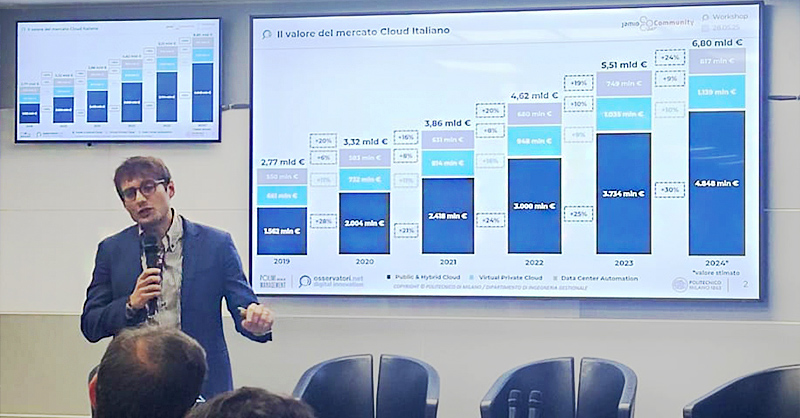
At the latest Jamio Community Day , Luca Dozio – Senior Researcher at the Cloud Transformation Observatory of the Polytechnic University of Milan – brought a clear vision to the stage: the cloud is no longer just an infrastructure, it is the silent engine of digital transformation , and today more than ever the ideal platform for experimenting with and adopting solutions that drive innovation.
The Italian cloud market is experiencing extraordinary growth. In 2024, it reached €6.8 billion 30% growth in the Public & Hybrid Cloud segment alone. These numbers are striking not only for their size, but also for their direction: for the first time, spending on Infrastructure as a Service (IaaS) has surpassed that on SaaS, growing by 42% . This is a clear sign that Italian companies are becoming more mature in their use of the cloud, moving toward more advanced and customizable models.
But what makes the cloud truly strategic is its symbiotic relationship with AI . According to the Observatory, 87% of large Italian companies develop AI solutions in the cloud , increasingly relying on "as-a-service" models, both to begin experimenting (with vertical SaaS) and to build proprietary solutions (with PaaS and IaaS). And while AI leverages the flexible power of the cloud, the cloud relies on AI to improve itself , from dynamic resource management to coding automation and security monitoring.
In this rapidly evolving landscape, a trend is emerging that closely concerns the market in which Jamio operates : IT composability . Companies are increasingly seeking to build agile digital ecosystems low-code and no-code paradigms come into play , allowing applications to be created quickly, without writing code or with minimal technical skills.
Dozio emphasized , no-code represents a concrete response to the growing need for collaboration between business and IT : on the one hand, it enables business users to actively participate in digitalization, and on the other, it allows technical teams to focus on more complex and strategic activities. But with a strong focus on solid IT governance to avoid the risk of the proliferation of difficult-to-control "shadow IT."
Another fact to reflect on: 24% of the application landscape of large Italian companies is already containerized , a step toward vendor independence and greater service portability. The cloud, in short, is no longer a point of arrival, but an enabling platform for intelligent and informed innovation .
A speech full of ideas that can be explored further by downloading the complete slides presented by Luca Dozio , with all the data and graphs from the Cloud Transformation Observatory .
Even in August, Openwork customer service doesn't go on holiday!

The holidays are approaching, but Openwork's Customer Service remains fully operational to ensure timely and continuous support for customers and partners, even during the summer months.
So whether you're planning new ventures or simply managing ongoing work, you can count on our assistance every day, any time of year, even in summer.