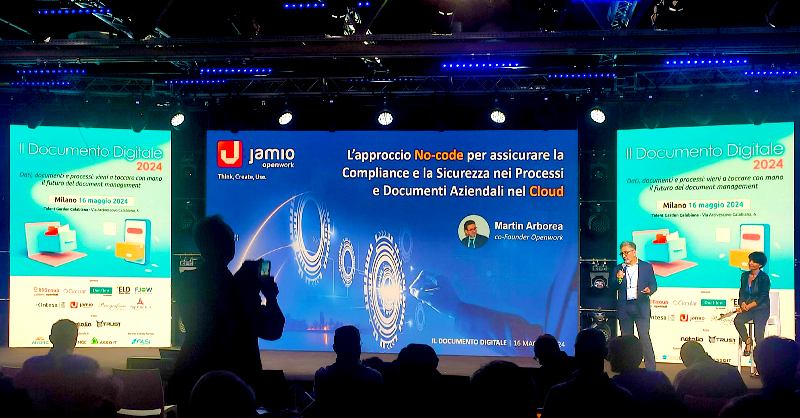







No-code, compliance, and security: we discussed these topics in Milan at "Il Documento Digitale 2024"
CORPORATE COMPLIANCE
Corporate Compliance occurs when an organization adopts procedures to ensure compliance with regulations, standards, best practices, guidelines, etc.; for example, Legislative Decree 231/01 (Administrative Liability of Legal Entities); Legislative Decree 196/03 and the GDPR; Legislative Decree 81/08 (Occupational Safety).
being compliant means organizing itself to prevent and avoid violations, sanctions, legal problems, protecting its image and avoiding possible reputational and economic .
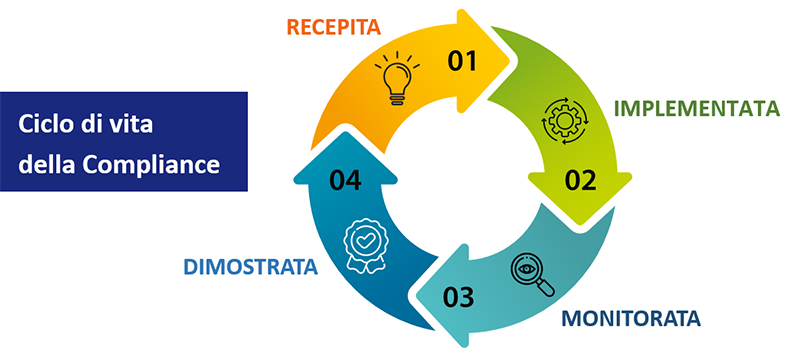
compliance lifecycle can be identified , which must be understood, implemented, monitored, and demonstrated. Demonstrating compliance is the final step in this cycle, often the one receiving the most attention.
NO-CODE & COMPLIANCE
Certainly some software solutions can help us to be compliant and we ask ourselves: what connection could there be between a no-code application development platform and these issues?
The no-code approach proves to be an effective solution for ensuring compliance and security in corporate processes and documents , especially when managed in the cloud. To understand how and why, let's start with the definition of Compliance provided by the Treccani Encyclopedia:
“… the set of rules, procedures and organizational structures aimed at enabling, through an adequate process of identification, measurement and management of the main risks, a healthy, correct and consistent management of the company with the objectives”.
This effectively means that a standard always translates into objectives that an organization must pursue and demonstrate having achieved. For this reason, an objective always translates into one or more actions . And each action must be measurable.
It then becomes easy to imagine how a no-code application development platform facilitates compliance management on two levels:
- Regulations and Standards : providing tools for account, data, document, process, and organizational management that help comply with regulations/standards such as the GDPR and Legislative Decree 231/01, etc.
- Internal Procedures : supporting the implementation and monitoring of internal procedures and ensuring that solutions are aligned with organizational processes.
COMPLIANCE BY DESIGN & COMPLIANCE BY DEFAULT
Specifically, the Jamio openwork implements the principles of " compliance by design" and "compliance by default ." This means that compliance is integrated into the design of solutions from the earliest stages of application development, and that they automatically, or by default, comply with regulations/standards/regulations during use. Furthermore, the platform offers monitoring and auditing tools to demonstrate compliance and implement corrective measures in the event of deviations.
We can define Compliance by Design as an approach to application development that allows for the creation from scratch or customization, verticalizing pre-built solution patterns, in specific application domains. In this sense, compliance is designed and implemented , and can involve the construction of workflows, the certification of document distribution within the organization, and their generation in compliance with standards and templates, "integrating generative artificial intelligence services."
Compliance by Default , on the other hand, includes the fact that during the runtime execution of monitoring and auditing are managed transparently to support the demonstration of compliance , the detection of deviations and the introduction of corrective measures.
In this context, the no-code approach enables rapid intervention , in response to changes in context and evolutions of the dictates to which compliance must be adhered to, with a view to a cycle of subsequent and incremental adjustments, in response to the resilience requirements of business processes.

USE CASES
There may be several application examples and ways to achieve these results.
Risk Management solutions , the very purpose of which is related to a process compliance pattern: in risk management, it is essential that the actions undertaken aim towards the achievement of well-defined goals, minimizing the risk of deviations that move the goal further away.
A significant example is that of a hospital that, to guarantee the quality and safety of care, adheres to the guidelines and standards established by JCI (Joint Commission International) which provide for;
- the implementation of protocols to reduce the risk of nosocomial infections
- training staff on patient management
- ensuring the availability of equipment and facilities that comply with safety standards.
In particular, the IPSG.5 states:
«The organization adopts a method to reduce the risk of healthcare-associated infections by carrying out and monitoring the following actions :
- Adopt current hand hygiene guidelines
- Encourage staff to adopt the procedure
The solution can define two indicators : for the first action, defining and distributing the procedure, a platform like Jamio easily allows for the implementation of document creation and distribution features as well as monitoring the exact percentage of users who have received and read it. For the second action, encouraging adoption, the indicator can be linked to verifying the understanding of the procedure, which can be measured by distributing a questionnaire and collecting the comprehension data .
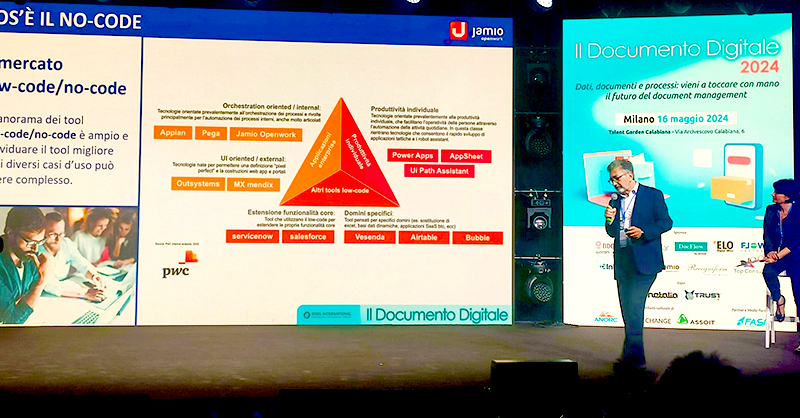
Other use cases were illustrated during the conference and are schematically reported in the slides.
Images of the day in Milan
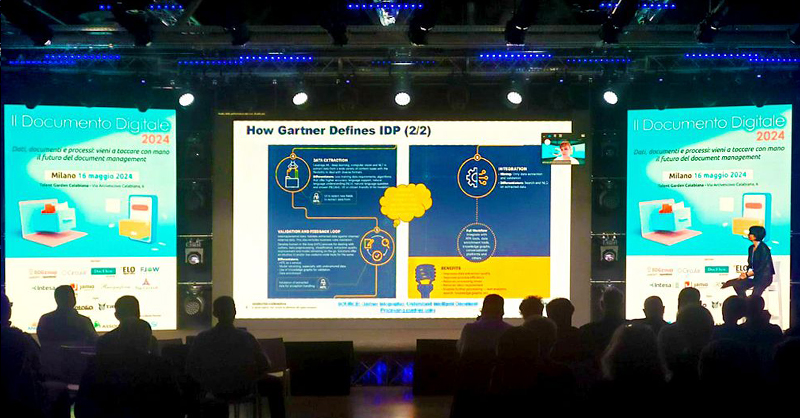
"Il Documento Digitale " is a format organized by SOIEL International dedicated to the topics of document dematerialization and digital process management. The Milan Openwork also participated in as a sponsor , took place on Thursday, May 16, 2024 at the Talent Garden Calabiana.