




Planning and implementing a successful digital transformation for an organization isn't an overnight . In reality, it's a transformation that has profound implications for organizational structures and must be designed and implemented with the involvement of all organizational resources. However, there are technologies that can be used to accelerate the entire process; among these, BPM (Business Process Management) technologies, an integral and enabling part of digital transformation strategies for many years.
Business Process Management (BPM) refers to the set of activities required to model, optimize, integrate, and monitor business processes to make a company's operations efficient and effective. Rethinking the company in terms of processes means implementing organizational and operational models that allow all stakeholders to share information and coordinate their actions based on shared, rather than individual, objectives.
Adopting BPM technologies means for an organization to embark on a new technological and cultural journey, which can speed up and simplify workflows, increase productivity, and improve competitiveness, making the organization flexible to market changes.
Robotic Process Automation (RPA) is emerging as a topic of interest for organizations seeking to digitize and thus streamline the many manual processes still performed by humans. The IRPA (Institute for Robotic Process Automation) defines RPA as " the set of technologies, products, and processes involved in the automation of work processes and uses so-called 'software robots' that can automatically perform repetitive tasks of operators, imitating their behavior and interacting with IT applications in the same way as the operator themselves. "
RPA technology is ideal for automating and optimizing repetitive manual tasks, allowing people to focus on higher-value tasks. Its adoption is typical for established and stable business processes, perhaps outsourced, easily defined through a set of closed rules that can be transferred to the robot, and that have no exceptions, or only a few that are easily resolved.
The characteristic elements of RPA technology can be summarized as follows:
- it can be defined as a software that replicates the actions otherwise performed by a human operator;
- can be implemented quickly and efficiently without altering existing infrastructure and systems;
- is focused on performing repetitive, time-consuming and manual tasks
Robotic process automation is gaining popularity in many sectors, especially finance, banking, and utilities, where procedures and best practices share the characteristics just described and can simplify and streamline repetitive manual tasks.
Examples of such automation are: searching for information on various sites, format translations, extracting structured data from documents, moving files and folders, filling out user forms, connecting to external systems, all by executing simple “if/then” rules.
Don't make the mistake of simplifying the terms BPM and RPA by overlapping them or considering them synonymous. They are two very distinct technologies with their own characteristics.
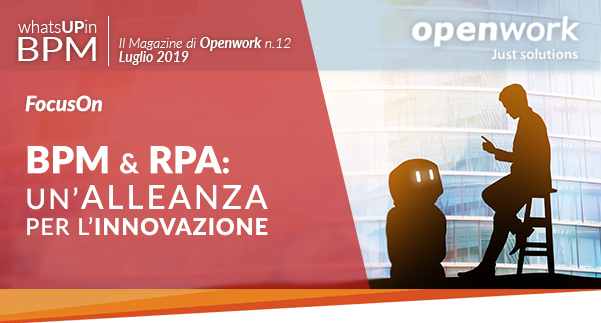
Their complementary use allows for the automation and management of end-to-end processes, maximizing the added value for the organization. Indeed, as a complementary tool to BPM, RPA can help companies become faster and more flexible by automating processes that are partially or completely unsupported by software and are always burdensome for humans.
At the same time, their combined use maximizes the benefits of BPM, thus investing more in human activities that require high levels of professionalism and greater specialization, streamlining unstructured processes, such as those related to certain approval circuits, and dynamically orchestrating human and system tasks across multiple processes governed and monitored by BPM solutions.
How to proceed?
The starting point is always a comprehensive analysis of the company's business processes, their modeling on a BPM platform, the identification of activities that can be delegated to a robot, and integration with RPA tools. The BPM platform enables this advanced approach to digital transformation by providing the ability to
- Integrating cognitive and AI tools to support intelligent process management
- Support the construction of Case Management applications
- Support integration with external services based on the most advanced standards such as Open API REST
For example, imagine the process of managing a mortgage application from a bank, completed online by a customer. The entire complex and detailed process will be modeled on the BPM platform and involves a series of human-intensive tasks such as verification, validation, and approval.
During the execution steps of the modeled process, tasks delegated to robots, such as automatically filling out forms that initiate the approval process with structured information from the request form or integrating with the bank's legacy systems to acquire customer risk data, generate the invocation of connectors from the chosen RPA component, which features the REST API protocol.
Ultimately, combining the flexibility and power of BPM and the use of intelligent robots typical of RPA is the key to achieving the goals of a successful end-to-end digital transformation.
 Editorial by:
Piero Cosoli – Senior Program Manager Openwork
OPENWORK SAILS WITH RANDSTAD TOWARDS NEW DIGITAL MODELS
 Bari, July 3, 2019 – The city of Bari takes a journey back in time with the arrival of the Randstad in the port of the regional capital. The ship is an exact replica of a 19th-century Dutch Clipper, built by Randstad itself to sail as an ambassador for employment and education.
And it was in the port of Bari, aboard the aforementioned Clipper Stad Amsterdam, that the daily cruise and a workshop titled "Computer Science and Philosophy: Could It Ever Be True Love?" were held.
The workshop analyzed the new development models brought about by the advent of artificial intelligence and the new ways of conceiving work resulting from the integration of humans and machines.
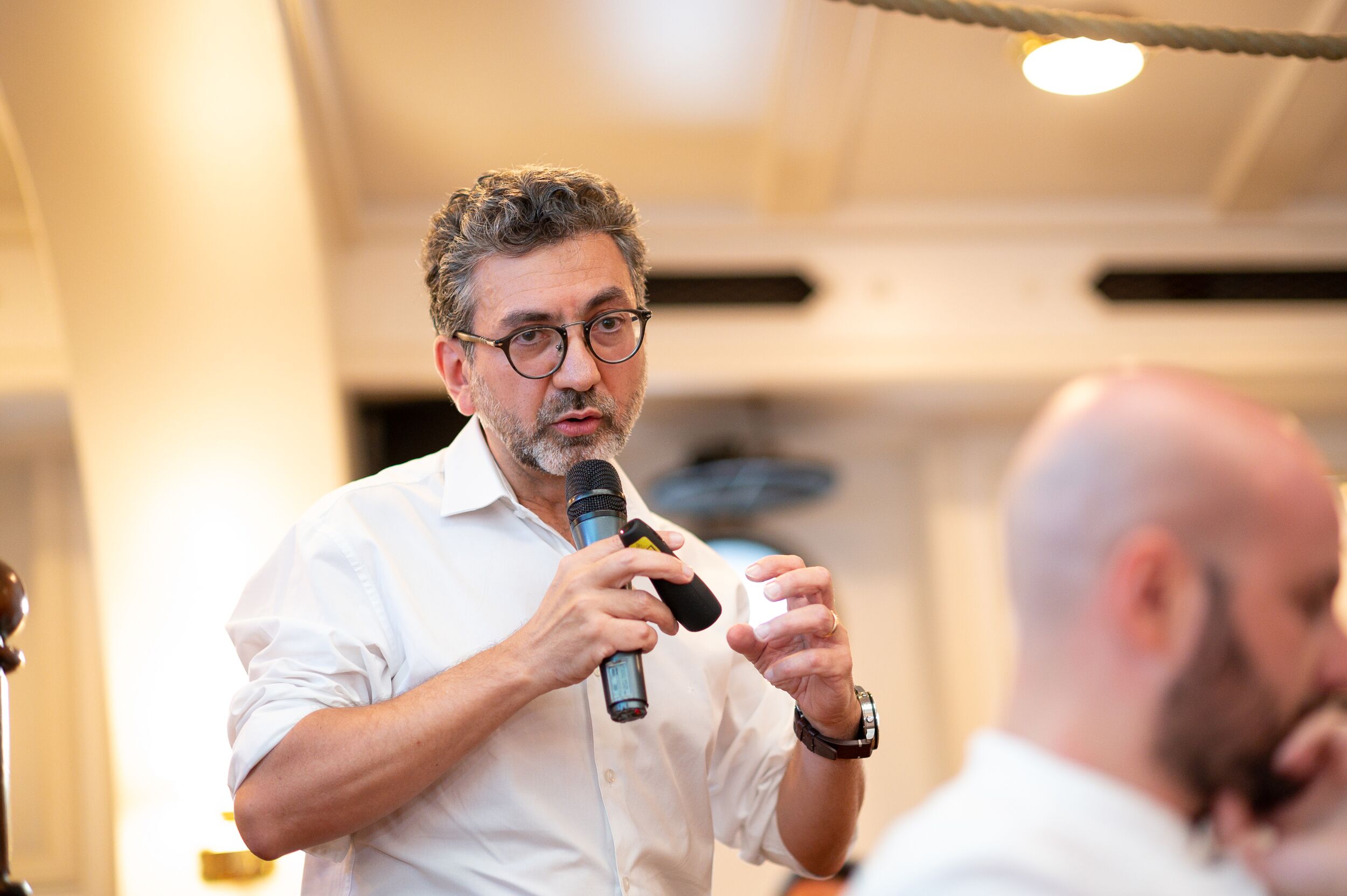
Speakers included Roberto Rossi (Head of Technologies at Randstad Italia), Martin Arborea (co-Founder & Sales Director at Openwork), Mariarita Costanza (Co-Founder & CTO Macnil Gruppo Zucchetti) and Andrea Geremicca (Co-Founder & CMO Impactscool).
Openwork confirms its position at the center of the digital innovation debate, zero-code development approach , which allows cloud applications to be created without programming knowledge. This is a winning response to another sensitive issue, the digital skills crisis plaguing Italian businesses.







OPENWORK WEBINAR – Discover the events with the new Openwork format

Openwork Webinar project is born , a broad program of webinars thanks to which the speaker will lead participants into the zero-code world of Jamio, from the comfort of their office, or at home, or from any device with internet access, on a set day and time.
Numerous topics aimed at different audiences: CIOs, IT managers or managers from other business areas, Jamio designers and users, VARs, consulting firms, etc. with the aim of raising awareness of Jamio, illustrating its features, peculiarities, functionality, new features, and application cases, bringing the audience as close as possible to Jamio's Model-driven cloud.
The first webinar, "The Future of Business Processes is Zero-Code," is already available online every Wednesday at 12:00 PM and every Thursday at 3:00 PM . The webinar will demonstrate the simplicity of the Jamio Openwork BPM platform's zero-code modeling approach, helping you build a step-by-step solution for digitizing business processes.
The second webinar “ 3 important new features of Jamio Marimba 4.5 ” which shows the new features of the latest Jamio versions will be available online every Wednesday at 3:00 pm and every Thursday at 12:00 pm.
Starting in September, you can also join the webinar " One Platform, Many Solutions ." A case study will illustrate a unique feature of the platform: Jamio allows you to create an unlimited number of solutions for the same organization and use them from a single workspace, sharing data and information.
Open for Holidays: The Cloud Never Goes on Vacation
 The Jamio Cloud isn't taking a vacation! We remind you that Customer for Jamio openwork customers will remain operational throughout the month of August to ensure customers and partners get the support they need.
TAKE A MINUTE TO EXPLAIN HOW JAMIO CAN CHANGE YOUR WORK
In an ever-evolving market, technology needs to adapt to your needs.
Here's the Jamio video.