











Jamio lowcode nocode cloud platform
Jamio software platform for agent-based AI processes

MAGAZINE N.73 | Agentic AI: More distributed intelligence, more accountability for those who govern it

Every organization has always sought a balance between what it can do and what it can manage. It's a question that has permeated the history of business: delegating tasks, distributing responsibilities, introducing tools, and building processes that make work more effective.

Today, with artificial intelligence and the evolution of agents, this balance faces a new dimension. It's no longer just a matter of providing people with more powerful tools, but of empowering intelligent systems to interpret information, make decisions, and perform actions within processes.

Autonomy thus becomes a promise of efficiency, but also a new organizational responsibility. Because every time a task is delegated, the need to manage it doesn't disappear. Rather, the way it must be performed changes.

It is precisely from this reflection that the theme of sovereignty in the era of Agentic AI, at the center of the speech by Salvatore Latronico, CEO of Openwork, at The Elephant in the Room, the event that brought together experts and professionals to reflect on artificial intelligence and its implications for organizations.

Sovereignty is revealed in the exception

What does it mean to be sovereign? The question, seemingly distant from the daily life of a company, becomes surprisingly concrete when we observe what happens in moments of disruption.

"Sovereign is he who decides on the state of exception." This quote from jurist Carl Schmitt invites us to look beyond the ordinary functioning of things. As long as everything proceeds as planned, an organization may appear fully under control. Dependencies, technological choices, and operational constraints remain in the background, because they do not impede the progress of activities. It is when something changes that its true capacity for governance.

A supplier changes its financial conditions, a service becomes unavailable, a technology can no longer be used as before. At that point, the question is not only how much the organization depends on a given solution, but whether it is still able to understand what is happening, make a decision, and intervene.

This dynamic can affect very different areas. An energy supply crisis, for example, can transform a cost issue into a resource availability problem. Similarly, in the technology world, a service that was initially free or very cheap can suddenly become expensive. This is the case with solutions that, once deeply embedded in company processes, make it difficult to react to a change in the supplier's conditions.

Dependence, therefore, does not automatically equate to a loss of sovereignty. The problem arises when it becomes impossible to govern its consequences. If an organization has built essential activities around a technology and has no viable alternatives, changing the conditions of use can become a constraint that limits its ability to make decisions.

The same question applies toartificial intelligence. Outsourcing a process to an external service can be an effective option, but it also requires considering what might happen if that service becomes more expensive, changes features, or becomes unavailable. Therefore, evaluating a technology cannot stop at its current usefulness: it must also include its ability to address changing conditions.

Sovereignty, from this perspective, doesn't necessarily mean possessing technology. It manifests itself in the ability to address the unexpected, without losing the ability to choose. It means being able to gather information, evaluate alternatives, make decisions, and implement corrective measures, rather than simply being subjected to events without any room for maneuver.

Autonomy changes scale

To understand the transformation brought about by intelligent agents, we can start with a simple observation: people within organizations interpret, decide, act, and collaborate. It is on these activities that roles, processes, responsibilities, and controls are built.

Agents tasks , but with one key difference: they can operate at very high speeds, process large amounts of information, and collaborate with multiple other agents. What's new, therefore, isn't just what agents can do, but the scale at which they can do it.

An activity that previously involved a single person or process step can become part of a larger sequence, in which multiple agents and services intervene, exchange information, and complete tasks in a short timeframe. Not all AI capabilities require the same level of autonomy, and not all digital actors need to have the same role. Organizations thus find themselves having to coordinate different actors, each with different functions and operational capabilities.

As complexity and speed of execution increase, the need for an organizational model capable of supporting them also increases.

When speed exceeds government

Technology doesn't necessarily create entirely new problems. It often amplifies critical issues that organizations already face.

This is the case with fragmentation. Work environments are filled with local tools, spreadsheets, distributed information, and tasks managed outside of shared processes. This situation can make it difficult to know where data is located, who uses it, what tasks are being performed, and which process is actually being governed.

If local tools and initiatives can already multiply without overall coordination, as happens with the excessive and uncoordinated use of Excel spreadsheets, the introduction of agents with different levels of autonomy can complicate the phenomenon: the risk is that the multiplication of operational capabilities produces a multiplication of grey areas.

The problem isn't just the number of tools. It's the ability to reconstruct what's happening: what information is being used, what actions were performed, by whom or what, and within what process. When this visibility is lost, it becomes more difficult to identify errors, understand their causes, and intervene.

Fragmentation adds to other critical issues. A concentrated dependence on a few suppliers can become more significant; extensive automation can erode skills previously held within the organization; the use of external services can expose confidential information to unforeseen boundaries. And if tasks are entrusted to agents without a shared model, it can become unclear who actually has control over a decision or outcome.

Speed ​​alone doesn't guarantee a more effective organization. If it's not accompanied by visibility, rules, and accountability, it can make it harder to understand what's happening, address errors, and maintain a comprehensive vision.

Agentic AI business process management

Delegating does not mean losing responsibility

No organization grants unlimited power to its members. Activities are assigned based on roles, skills, responsibilities, and rules. Why, then, should we consider it natural to grant agents unlimited autonomy?

The question challenges one of the most widespread beliefs in the debate about artificial intelligence: that greater autonomy always corresponds to greater efficiency.

In reality, each delegation must be proportionate to the ability to govern its effects. An agent can perform an activity, evaluate alternatives, or intervene in a process, but it is necessary to determine which decisions it can make, what information it can use, and under what conditions human intervention is necessary.

It's not just a matter of defining in advance what an agent can do. It's also necessary to consider what might happen if it made a mistake, what consequences it might have, and how the organization could correct it. The level of autonomy, therefore, cannot be decided in isolation, based solely on the system's technical capabilities. It must take into account the risks and the effective ability to control them.

Greater autonomy can generate benefits, but it can also expose the organization to consequences whose costs outweigh the efficiency achieved. This requires establishing roles, rules, constraints, and thresholds beyond which a decision must be submitted to a single individual.

Managing autonomy doesn't necessarily mean limiting its value. It means defining the scope within which it can operate, so that delegation doesn't result in a loss of control. The agent can act, but the organization must be able to understand and govern the conditions of its action.

The freedom to be able to change

Another element of sovereignty concerns the possibility of change.

In the tech world, a solution can quickly become an integral part of a process. Information, procedures, and instructions can be built around a specific service or AI model. But what happens when that service changes conditions, becomes too expensive, or is no longer available?

The issue isn't just technical, but also organizational. An instruction set built for one technology may not behave the same way when transferred to another. Changing a vendor, therefore, doesn't automatically guarantee the continuity of the capabilities developed.

If a company fails to transfer knowledge, procedures, and operational capabilities, switching suppliers can become a much broader challenge. Dependence no longer concerns only the tool used, but the wealth of skills and processes that have been built around it over time.

Portability, therefore, cannot be considered a step to be undertaken only when the need for change arises. It must be taken into account in the way processes are designed and technologies are introduced: it is necessary to preserve, to the extent possible, the knowledge, instructions, and operating conditions that allow an activity to continue even with different tools.

Sovereignty, then, also includes the ability to change direction. It doesn't mean avoiding all dependence, a goal difficult to achieve in a complex technological ecosystem, but it does mean preventing a dependence from becoming a renunciation of the ability to choose.

Intelligence can be distributed.
Responsibility cannot.

Governing an organization with people, agents, and AI services requires a model that combines knowledge, processes, and accountability. These aren't three separate domains: each enables the others to function.

The first capability concerns the management of knowledge and access to information. It's not enough to know that an agent is capable of performing a specific task: it's necessary to know what data it can access, what information it uses, and where it transfers it. As with people, agents must have an identity and role consistent with the tasks assigned to them. Authorizations must be proportionate to that role, avoiding indiscriminate access to the organization's information assets.

The second capability is the orchestration of people and agents within processes. In a hybrid model, not all activities need to be entrusted to the same individuals. Some may be performed by an agent, others require a person, and still others may require human verification or approval. Orchestration means defining these relationships, establishing how activities flow, and coordinating individuals with different capabilities and levels of autonomy.

The third capability concerns the management of controls, accountability, and results. Even when an activity is performed by an agent, it must remain possible to understand what has been done, what results have been achieved, and who is responsible. Control cannot be reduced to an occasional check: it must be part of the operating model, so as to make actions identifiable and allow for the correction of any errors.

These three capabilities support each other. Without knowledge governance, agents might use information inconsistent with their roles. Without orchestration, people and systems risk operating in a fragmented manner. Without controls and accountability, the organization might be unable to reconstruct what happened and act on the results.

Agentic AI business process management

Economic sustainability is also linked to these dimensions. The cost of an AI-based process depends not only on the service fee, but also on the model used, its frequency, and its deployment methods. A very powerful tool can also be used for simple tasks, with resource consumption disproportionate to the value produced. Therefore, the choice of model and service should consider, task by task, the required skills, cost, data sensitivity, and level of risk.

The ability to direct different activities towards different models thus becomes part of process management: there isn't necessarily a single solution that's right for every task. The choice must be consistent with what needs to be done and the constraints the organization must meet.

These dimensions bring attention to an essential point: intelligence can be distributed, but the organization's governance must remain recognizable.

The challenge isn't to make every agent increasingly autonomous, nor to transfer every possible activity to an intelligent system. It's to build an organization capable of deciding where autonomy generates value, what limits it must respect, and how to intervene when conditions change. Because true evolution isn't an organization that delegates everything, but an organization that knows how to delegate without losing itself.

From this perspective, the future ofAgentic AI will be measured not only by the ability of systems to act, but above all by the ability of organizations to continue to make timely and independent decisions.

Academy Jamio openwork

How a Jamio solution is born: when Agile methodology meets Model Driven

Jamio Openwork Model-Driven Agile Method

Not all digital solutions are created equal.

In some cases, the organization chooses a vertical application, already designed for a specific area: the work consists of configuring what the product offers. This is an effective approach when the organization's processes match those envisioned by the solution, when the organization has the flexibility to adapt, or when, in the initial stages, it hasn't yet defined in detail how certain processes will operate and is guided by the logic and best practices incorporated into the vertical software.

However, there are different situations: processes with their own rules, needs not covered by vertical software, exceptions that are not anomalies but are part of the specific daily work of that organization . Here, the question is not "what software can we configure?", but "how can we translate the way we want to work into software?" This is where the combination of Agile methodology and Model-Driven approach becomes particularly effective in building an application solution.

The customer is not just the client

When a solution is built around an organization's needs, the necessary knowledge isn't entirely held by the software developer. A key component lies within the client organization: the people who understand the process, handle exceptions, understand the meaning of the data, and know why, under certain circumstances, a decision should be made one way rather than another.

For this reason, the project requires the involvement of a team of client stakeholders, capable of representing the needs and objectives of the various areas involved. The client team's contribution transforms knowledge distributed across people, documents, and operational practices into a shared representation of the process: who does what, what information is needed, where and how decisions are made, and what happens when the standard path isn't enough.

Agile: design without waiting for the end

Agile, this translates into a precise rhythm: we start with a Kick-Off, where we analyze the material shared by the client—a pre-mapped process, existing documents, procedures, examples, or simply a list of requirements—and together we build the work plan.

From there, the project progresses through Sprints, short intervals in which a portion of the solution is modeled and made testable. At each cycle, the Jamio team and stakeholders meet during the planning phase to define what needs to be worked on and during the review phase to verify what has actually been achieved. Therefore, the requirements and documents aren't just discussed: the solution as it takes shape is gradually observed and tested.

At the end of development, we enter the UAT – User Acceptance Test, the testing by the customer, with an agreed period in which to verify the entire solution, report any non-conformities and make any final planned refinements.

The process concludes with the training of key users. However, there is an important advantage: the people who participated in the project are not encountering the solution for the first time during the training. They have already seen it evolve, tested it, and contributed to the decisions that led to its final form.


Model Driven: From Requirement to Solution

This is where the Model-Driven demonstrates one of its main advantages. The process isn't just described in analysis documents intended to be later translated into code.

Data, forms, roles, rules, workflows, documents, and integrations are progressively represented through models that quickly become part of the application solution. If a task needs to be assigned to a different role or a step requires control, the model is modified.

The gap between decision making, modeling and verification is reduced.

This makes the encounter with Agile particularly natural : what emerges from the discussion with the client can quickly transform into something concrete and verifiable, often already in the subsequent review.

Agile workflow nocode method Jamio

A concrete example

Let's imagine an internal request management process. At first, it might seem like all it takes is to create an entry form, add a confirmation, a review, and a closure.

However, delving into the details raises many questions: Who can open the request? Who decides its priority? When should another function be involved? Who can modify the information after it's been accepted? What happens if the request is rejected? Who should be notified? What information should be tracked?

In an Agile and Model-Driven , these decisions are addressed together, client and supplier, step by step. The first release, for example, covers onboarding and acceptance: users test it and collect observations; in the next cycle, priorities and exceptions are addressed, then notifications and integrations are added. This doesn't mean developing "without designing." It means designing while continually verifying that what we're building truly corresponds to the way the organization needs to work.


The price of customization: participating

This approach has one specific condition: the customer must be there.

Customization doesn't mean ordering a solution and waiting for it to be delivered. It means making the right people available at the right times, making decisions, comparing perspectives across different functions, and dedicating time to verifying what is being achieved.

Above all, it means carrying out an often invisible but crucial task: extracting domain knowledge from people and transforming it into shared rules, data, responsibilities, and processes.

It's a greater commitment than adopting a ready-made solution, but it's precisely this investment that allows us to arrive at a best-fit solution that's tailored to the context, manageable over time, and easier to adopt.


The effort that pays off: faster adoption

There is one aspect that the customer often does not take into account when evaluating this initial commitment: participation is not just a cost, it is an investment that pays for itself at the time of adoption.

A user who has participated in planning and reviews doesn't discover the tool on the day it goes live: they've watched it grow, they've tested it, and they've seen their observations translate into concrete decisions and changes. A significant part of organizational change therefore occurs while the solution is being built, not afterward.

The effort required during the project can thus reduce the time needed to adopt and master the tool: less cold training, fewer surprises, less resistance to change.


The advantage is not only in speed

A solution built together with stakeholders avoids information and steps with no real value and is born adherent to the context, not to a standard model adapted to the context.

There's also a less expected effect: modeling a process forces you to look at it. When you need to determine who can perform an action, what data is really needed, why a certain step exists, or how an exception should be handled, people inevitably begin to question how they work. The digital project thus also becomes an opportunity to simplify procedures, eliminate redundancies, and make explicit rules that until then had remained implicit. And there's no need to start from the entire perimeter: you can digitize a segment, use it, and then extend the solution to another, in an incremental logic. In this sense, the project doesn't just produce digitization: it also becomes an opportunity for process reengineering.


Collaboration as part of the solution

Agile and Model Driven shift the focus of the project: from the delivery of software to the progressive construction of a shared solution.

The Jamio team brings design, modeling, and platform expertise. The customer brings knowledge of their domain, processes, and rules. Stakeholders are the point of contact between these two worlds. Jamio provides the platform on which this collaboration can quickly transform into a concrete application solution.

Incremental logic doesn't necessarily end with the first go-live. The same solution can continue to evolve over time, adapting to the organization's new needs, rules, and processes.

This is the value of the meeting between Agile and Model Driven: not only developing faster, but understanding better what to build, testing it first, and arriving at the moment of adoption with a solution that the organization has already begun to know and make its own, ready to evolve together with its needs.

From the Jamio Openwork No-Code blog

Openwork and the Food Drive: the value of being there

Openwork Eurospin Bari Food Collection

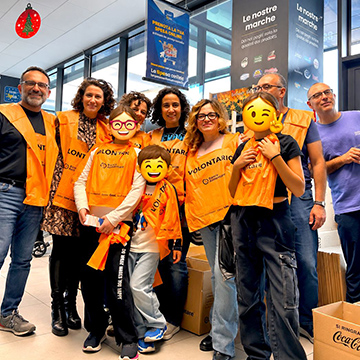
Solidarity takes shape in small gestures. On Saturday, November 14, some Openwork, along with their children, volunteered at the Food Drive at theEurospin supermarket on Via Bovio in Bari, dedicating their time and enthusiasm to an initiative of great social value.

It was a day of meetings, smiles, and participation, reminding us how even a small contribution can make a difference, for those who receive it and even more so for those who give it. We often don't realize how much solidarity there is around us until we have the opportunity to experience it firsthand.

Furthermore, the presence of the little ones made this day even more special. Participating firsthand gave them the opportunity to discover the value of sharing and caring for others, through a tangible and joyful experience.

For Openwork, initiatives like this represent an opportunity to meet outside of the workplace, strengthening the sense of community and the value of relationships between people.
Because this is how the common good is born: from many small gestures that, together, become something big.

RELATED BLOGS

MAGAZINE N.12 – BPM AND RPA: AN ALLIANCE FOR.

Planning and implementing a successful digital transformation for an organization isn't an overnight process. In.

Openwork Jamio Digital Maturity Scale
MAGAZINE N.27 Digital Maturity Scale: and the.

 If it is true that 2020 was the year of collective awareness, especially on the part of SMEs, about the.