









The partnership's first result is Presidio | Adeguati Assetti, a cloud service on the Jamio openwork platform for planning, verifying, documenting, and monitoring adequate assets required by Article 2086 of the Italian Civil Code.
Openwork Srl and LUM Enterprise Srl, a spin-off and Digital Partner of LUM Giuseppe Degennaro University specializing in research and consulting on business organization and processes, have entered into a partnership to develop and bring to market solutions dedicated to corporate governance.
The first result is Presidio | Adeguati Assetti: a cloud service provided on the Jamio openwork platform that supports companies in implementing the adequate structures required by Article 2086 of the Italian Civil Code.
A duty that concerns every society
Since 2019, Article 2086 of the Italian Civil Code requires entrepreneurs operating as corporate entities to establish an organizational, administrative, and accounting structure appropriate to the nature and size of the business, including for the timely identification of crises. The Italian Code on Corporate Crisis and Insolvency has further clarified its function: the structures must enable the identification of any imbalances, the verification of debt sustainability, and the prospects of business continuity.
The requirement is the same for all businesses with no turnover or employee thresholds. However, the level of structure required varies, as the structures must be proportionate to the nature and size of the business.
In practice, the question administrators and supervisory bodies ask is not only whether the structures are adequate, but whether it is possible to reconstruct what was verified, what was decided, and what was done. A one-time checklist does not answer this question.
What Presidio Does | Adeguati Assetti
Presidio is the tool with which the company organizes, in a single environment, the activities relating to its assets. The service is divided into four functions:
- Plan: define the necessary actions, priorities, responsible parties, and deadlines.
- Verify: Conduct an assessment of 233 controls across 13 governance areas, from governance to treasury, from procurement to early warning.
- Document: collect evidence and results of checks, control by control.
- Monitor: track the status of actions, periodic checks, and critical issues over time.
Each control is classified into one of four statuses (monitored, needs improvement, criticality, needs evaluation). A dashboard provides an overview and allows for detailed analysis of individual controls. The solution does not certify the adequacy of the structures: this assessment remains the responsibility of the corporate bodies. Instead, it makes it possible to reconstruct and demonstrate the path the company has taken.
Four perspectives on the same path
The service is designed for individuals who, with different roles, are called upon to manage the assets:
- the administrator, who must be able to demonstrate the path taken;
- the board of directors, which makes decisions on the basis of documented checks and monitors the implementation of the interventions;
- the board of auditors, which has evidence of the company's checks and actions to support its supervisory activity;
- the auditor, who gathers evidence relevant to the audits under his responsibility.
Everyone has access to information relevant to their role. Assessments and conclusions remain with the professionals.
Technology and skills
In the partnership, Openwork provides the Jamio openwork platform, an ACN QC2 qualified SaaS service delivered with an ISO/IEC 27001, 27017 and 27018 certified management system.
LUM Enterprise provides research and consulting expertise in business organization and processes. The company, based in Casamassima (Bari), was founded in 2015 as a spin-off ofLUM Giuseppe Degennaro University, as part of the Smart District 4.0 project, funded by the then Ministry of Economic Development. Today, it is an independent company and operates as a Digital Partner of LUM University, tasked with transferring the expertise developed in the academic field to businesses.
Its activities range from industrial research to digital innovation, from artificial intelligence to sustainability, from subsidized financing to process organization. It has been an innovative SME since 2022 and is UNI EN ISO 9001:2015 certified. In Presidio | Adeguati Assetti, LUM Enterprise collaborates in the development of the service and its dissemination among companies.
The decision to build Presidio on Jamio openwork responds to a specific need: a system for managing assets must be able to evolve with the company, accommodating new controls, new managers, and, when necessary, the digitalization of the processes that generate data and evidence.
A line designed for other compliance areas
The name of the solution refers to a line, not a single product. The prefix "Presidio" identifies the approach: planning, verifying, documenting, and monitoring. The suffix indicates the scope. "Adeguati Assetti" is the first. The two companies intend to extend the same approach to other compliance areas.
The Cloud & Cybersecurity Voucher
Presidio | Adeguati Assetti is a subscription-based cloud service. Eligible companies can consider accessing the MIMIT Cloud & Cybersecurity Voucher, which provides a non-repayable grant of up to 50% of eligible expenses, with a maximum of €20,000, for subscriptions lasting at least 24 months. Applications are open from 12:00 PM on November 10, 2026, in chronological order and until resources are exhausted. Consulting services are not eligible expenses, and expenses are eligible only if incurred after the application is submitted.
How to learn more
The page dedicated to Presidio | Adeguati Assetti describes the service, its four functions, and the voucher requirements.
Jamio Community: A new series of webinars and Web Tech meetings is underway

On Tuesday 27 October, with the webinar dedicated to Jamio Ouverture 6.0 , a new series of events aimed at the Jamio Community began , designed to share the evolution of the platform, explore its features in greater depth and discover new opportunities for its use.
The first meeting was dedicated to the new features of the new major release and the possibilities offered by the new Jamio On Stage NEXT.
Through a live demonstration of a supplier qualification solution, we explored the new user experience, the features that simplify daily work, and the integrations with Microsoft 365 and Power BI, showing how Jamio Ouverture 6.0 not only allows you to improve what you already do, but also enables new application scenarios.
This first webinar inaugurates a journey that will continue with webinars, Web Tech meetings, and thematic insights, offering customers and partners new opportunities to learn about Jamio's potential, discuss ideas, and find inspiration for their own application solutions.

Didn't attend the webinar or would you like to watch it again?
Cloud Observatory 2026: Sovereignty and AI put to the test of governance.

The conference presenting the 2026 Research Report captured a growing cloud market, digital sovereignty on the agenda but still limited to data residency, and Artificial Intelligence reaching companies faster than its governance. The report by Openwork, sponsor of the Research Report, and our interpretation.
On October 16, 2026, the Cloud Ecosystem & Sovereignty Observatory of the Digital Innovation Observatories of the Politecnico di Milano presented the results of the 2026 Research Report, "Cloud & Sovereignty: the European digital ecosystem between ambitions and reality." Openwork supported the Research Report as a sponsor and participated in the conference. We chose to share a report with our community for two reasons: the themes at the heart of the Research Report—sovereignty, dependency management, and AI adoption—are the same ones we work on every day with clients and partners; and the Observatory's data offers a solid and independent basis for discussion, beyond our own opinions. For this reason, the report carefully separates what emerges from the Research from our reading, which you can find in the last part.
The empirical basis is broad: a survey of 203 large and very large Italian organizations, divided into 73 trend-setting (over 1,000 employees and revenue exceeding €250 million) and 130 large enterprises; a survey of 1,500 companies from 14 European countries; a survey of 200 SMEs; approximately 50 case studies; an analysis of the M&A transactions of the 47 leading global providers in the digital supply chain; and a discussion with an Advisory Board of 23 C-level executives. The distinction between trend-setters and large enterprises is key to understanding the entire research: the former, more mature in the cloud, tend to anticipate the dynamics that the latter will experience.
The program alternated presentations of the results with testimonials from companies and industry professionals. This report focuses on the three presentations with which the Observatory presented the research: Alessandro Piva, Director of the Observatory, on the European scenario; Stefano Mainetti, Scientific Director, on the cloud strategies of trend-setters; and Mariano Corso, Scientific Director, on sourcing, skills, and AI.

THE SCENARIO
Sovereignty: from protection measure to condition for competition
Alessandro Piva, "The Role of the Cloud in the Current Landscape of Uncertainty and Instability"
Piva's starting point is a shift in posture. In 2025, geopolitical tensions had brought digital sovereignty to the fore as a mechanism for protecting against dependence on non-EU players. In 2026, digital is recognized as a pervasive infrastructure that supports even distant industries, and sovereignty becomes an enabling condition for competing in the markets that AI is reshaping: protecting, building capacity, competing.
The definition adopted is that of the European Commission: the Union's ability to exercise its independence in the digital domain while remaining open and connected to global networks. Not self-sufficiency, not autarky, not isolation from global supply chains, but strategic autonomy: control of critical technologies, bargaining power, and distinctive capabilities in key areas. This is the approach taken by the Tech Sovereignty Package presented on June 3, 2026, which brings together the Cloud and AI Development Act (CADA), the Chips Act 2.0, the EU Open Source Strategy, and the roadmap on digitalization and AI in energy.
This ambition, however, is measured against a highly concentrated global supply chain. Of the 327 technology-focused M&A transactions analyzed ($243 billion), 140 involve AI: 43% of the total, worth $105 billion. Over 90% of North American capital remains in the region. Providers' IaaS and PaaS revenue in Europe is estimated at $131.4 billion in 2026 (+29%), but 92% is driven by US players, and the three main hyperscalers alone account for 68%, up 3 points. The research highlights that a significant portion of this growth comes not from corporate spending, but from investments in AI infrastructure along the supply chain.
In Italy, organizational cloud spending reached €9.48 billion (+17%), driven by AI and cybersecurity. Public & Hybrid Cloud is worth €6.8 billion: IaaS remains the largest component (approximately €3 billion, +14%), SaaS is the most dynamic (€2.6 billion, +20%), driven by IT security tied to NIS2 and ready-to-use AI applications; PaaS is growing by 16%. Virtual Private Cloud is up 19%, for two reasons: regulatory requirements and data sovereignty, which require direct control over critical loads, and the costs of AI workloads, for which the on-demand model can prove costly and unpredictable. The research's conclusion is clear: the race for infrastructure has not yet translated into equally widespread use of AI among organizations.
SOVEREIGNTY IN BUSINESSES
We act, but sovereignty still coincides with the residence of the data
Mariano Corso, "Governing a Changing Cloud Ecosystem: Skills and Sourcing Models"
The course begins with a de facto dependency:86% of trend-setters' spending on IaaS and PaaS services goes to US hyperscalers (74% in large enterprises). The higher figure among more mature organizations is explained, according to the research, by migration paths that began earlier and with greater intensity.
In this context, sovereignty is beginning to translate into concrete choices: 63% of trend-setters have taken steps to ensure greater data sovereignty and control. The most commonly used lever is the use of European cloud providers for new projects (34%), followed by the creation of easily migratable application architectures (15%), sovereign cloud offerings from non-EU providers (11%), and open source (5%).
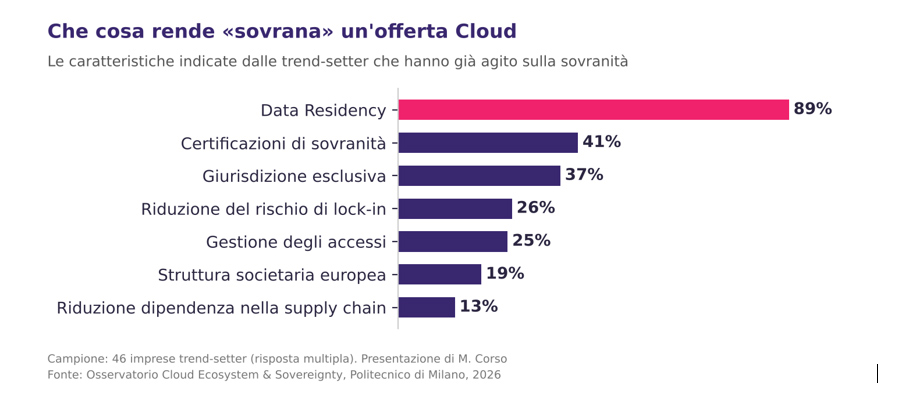
However, awareness remains partial. 70% of organizations reduce sovereignty almost exclusively to data residency, and even this is controlled more by obligation than choice: among trend-setters, 38% consider it a regulatory requirement, while only 13% consider it a strategic choice.
The research proposes three fundamental dimensions of cloud service sovereignty: the physical location of data in the Union; exclusive European jurisdiction over the provider and the data; and logical and operational control, i.e., the guarantee that cryptographic keys, privileged access, and service administration are in the hands of the client organization or European entities. This leads to perhaps the most important message of the report:
"Digital sovereignty doesn't require eliminating dependence on providers, but rather being able to govern it: knowing where it is concentrated, maintaining control, and having alternatives available when it becomes critical."
Report: "Cloud Scenario 2026: Market, Sovereignty, and New Sourcing Strategies"
Even open source, one of the levers on which the Union is focusing most, remains marginalized: it is a priority strategic choice for 2% of trend-setters and 7% of large companies. Barriers include a lack of internal expertise and the absence of adequate enterprise support. The regulatory framework makes them more stringent: NIS2, the Cyber Resilience Act, and DORA extend organizations' responsibility to the entire software supply chain and require identifiable counterparties with formalized obligations and service levels.
TREND-SETTER STRATEGIES
Mature cloud: the perimeter has moved, the model hasn't yet
Stefano Mainetti, "A mature cloud, a capacity for choice to be reclaimed: photography 2026"
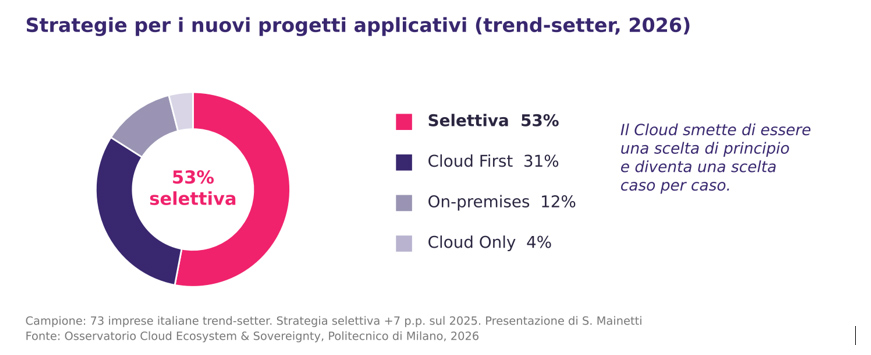
Mainetti used the metaphor of a climb: companies have reached base camp, now the scenario is becoming more extreme. For new projects, a selective is now the standard (53% of trend-setters, +7 points), followed by Cloud First (31%). The percentages are reminiscent of 2019, but the context is different: in the meantime, four out of five workloads have left the company's perimeter.
The geography of workloads is also changing. The off-prem data center (colocation and hosting) share rises to 29% of workloads, up 22 points compared to 2024, while public and private clouds fall from 61% to 57%. "For years, we've been dismantling the on-prem DC to move to the cloud. Now we're rebuilding the DC, but off-prem": the building is being outsourced, not the management. Hybrid adoption affects 80% of trend-setters and is now a condition rather than a choice; multicloud remains at 46%, and Mainetti poses the question directly: multicloud by choice or by accumulation?
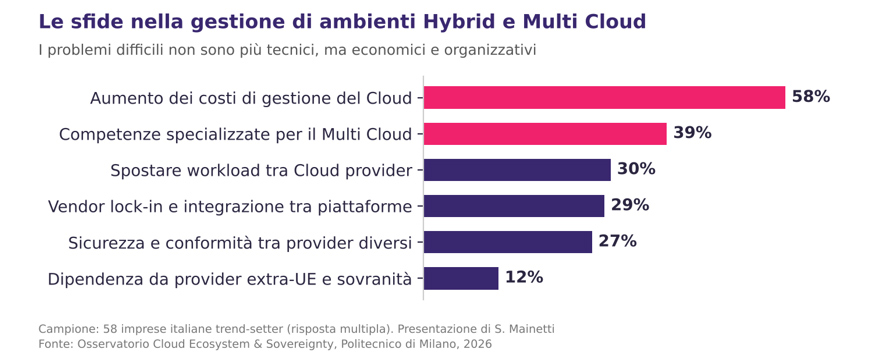
The challenges, in fact, are no longer technical. At the top of the management challenges of hybrid and multi-cloud environments are rising costs (58%) and specialized skills (39%); workload portability and lock-in, two sides of the same coin, follow closely behind.
The current front is modernization. Trendsetters estimate that 30% of the application portfolio still requires intervention (41% in 2024 and 39% in 2025), but the push is largely mandatory: 69% are modernizing due to technological obsolescence or end-of-support, and 28% due to limited functional flexibility. The core business, Operations, remains to be addressed: according to the report, Operations and Production are the priority areas for 51% of trendsetters over the next twelve months. Refactoring and SaaS are now tied at the top of migration choices ("rewrite what differentiates, buy what doesn't"), while the Cloud Native paradigm remains in the minority: containers account for 13% of the application portfolio. In Mainetti's summary, so far the Cloud has been primarily a change of direction, not of architecture.
CLOUD AND AI
AI enters the company faster than its governance
Three out of four trend-setters are already working on AI (58% have applications in production, 17% are experimenting), and of these, 80% purchase it ready-made in SaaS. "For now, AI is bought rather than built," observes Mainetti: faster, but more dependent, because delegation is concentrated on a few vendors. Overall, 51% of large Italian organizations use AI applications delivered as a service.
It's precisely the ease of adoption that makes governance more difficult when use scales. Among companies seeing cloud spending grow or become unpredictable, 37% point to AI workload consumption and 35% to the complexity of pricing models; 20% report the proliferation of SaaS licenses, often introduced independently by businesses. Corso added data from the HR Innovation Observatory: 51% of Italian workers supplement or replace official company-provided tools with their own external tools. This is the breeding ground for Shadow AI.
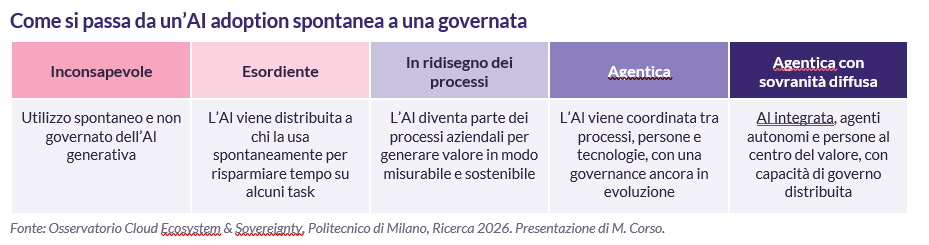
To describe the process, Corso presented a five-stage model, from spontaneous to managed use. Most Italian organizations are in the early stages, with a low level of awareness.
The report draws a clear conclusion: there is no single AI sourcing model that will prevail today. Maturity corresponds to the ability to revise one's choices as scale, workload criticality, and cost structure change, while maintaining visibility into the solutions in use and their associated spending.
THE INDICATIONS
Five levers and a rope team
Corso concluded by indicating five levers to transform complexity into governance capacity, in an ecosystem where sovereignty constrains technological choices and AI multiplies data, models, and dependencies to be governed:
- Evaluate scenarios and dependencies
- Manage your sourcing portfolio
- Manage data, contracts, suppliers and costs
- Designing reversible architectures and processes
- Developing AI governance capabilities
Mainetti broke down the same idea into three directions: redesign, not just move, because the scope has shifted but the model hasn't yet, and reversibility is built into the architecture; portfolio, not dependencies, that is, multi-cloud by choice, not by accumulation, and on AI from the start; making explicit what is being endured, making costs and technical debt parameters of decisions, not constraints discovered after the fact.
"We've learned to choose. Now we need to be able to change our minds. The CIO doesn't scale alone: he works in tandem with the business."
Stefano Mainetti, Scientific Director of the Observatory
The same image concludes Piva's speech: institutions, supply chains, and organizations must jointly build capabilities, alternatives, and skills, balancing innovation, control, and the ability to adapt to disruptive scenarios. "Reaching the summit requires a team capable of adapting.".
OUR READING
Where the results intersect with Openwork's work
The research focuses primarily on infrastructure and sourcing. Openwork is not a cloud provider: it produces Jamio openwork, a model-driven cloud process orchestration platform. For this reason, we're interested in an aspect that runs through all three interventions: governance isn't limited to choosing where to run workloads, but also involves the level at which the organization decides how to work with its data. Let's analyze the findings in three key points.
1. Logical control also passes through processes
The third dimension of sovereignty identified by the research—logical and operational control—is the one companies give the least consideration. Alongside cryptographic keys and administrative access, a significant part of that control lies in the rules by which data is processed: who can do what, at what stage, with what authorizations. When this logic is dispersed in code or in SaaS applications adopted independently by the business, it's difficult to see and even more difficult to review. In Jamio, data, processes, and rules are modeled and immediately operational: the model doesn't generate code, it's the application itself. The logic therefore remains explicit, readable, and traceable. This doesn't resolve the infrastructure issue (where the computation runs, under what jurisdiction), which remains a sourcing choice; however, it makes the layer where the organization decides what to do with its data governable.
2. "Redesign, not just move": the front is the core
The research places the next wave of modernization in Operations and Production, that is, in the processes that differentiate the company, and describes a choice that today lies between rewriting (refactoring) and buying (SaaS). For those processes, there is also a third option: modeling them, in an environment where the designed model is the same one that goes into operation and evolves at the pace of the organization. This is our application, at the process level, of the lever "designing reversible architectures and processes": a rule modified in the model is a rule modified in operation, without rewriting code. In a context where limited functional flexibility is the second reason for modernization, the ability to change ideas without rewriting is a requirement, not a secondary advantage.
3. From spontaneous AI to AI within processes
The model presented by Corso identifies the decisive transition as the stage where AI becomes part of business processes and generates measurable value, and is then coordinated across processes, people, and technologies. This is a governance shift rather than a technological one: AI is governed when it enters a process with defined roles, rules, and traceability, not when individual tools are multiplied. This is the direction Jamio is moving in, which, in the profile published in the research booklet, describes itself as a governed, traceable, and compliant-by-design perimeter for orchestrating people, systems, and AI agents.
In summary
Research 2026 doesn't ask companies to eliminate dependencies, but to learn to govern them: knowing where they are concentrated, maintaining control over critical assets, and maintaining the ability to revise decisions as costs, scale, and requirements change.
For organizations, this means moving from sovereignty understood as compliance to a conscious strategy of autonomy and resilience. For those, like Openwork, who work on processes, it means making the organization's operations explicit and governable: this is where the ability to change one's mind ceases to be an intention and becomes a property of the system.
SOURCES
Cloud Ecosystem & Sovereignty Observatory, «Cloud & Sovereignty: the European digital ecosystem between ambitions and reality», Executive Summary of Research 2026, October 2026 (M. Corso, S. Mainetti, A. Piva, M. Ficagna).
Cloud Ecosystem & Sovereignty Observatory, «Cloud Scenario 2026: Market, Sovereignty, and New Sourcing Strategies», Report, October 2026 (A. Piva, M. Ficagna, L. Dozio, M. Natalucci, C. Sorrentino).
Piva, "The Role of the Cloud in the Current Landscape of Uncertainty and Instability"; S. Mainetti, "Mature Cloud, Regaining Choice: A 2026 Snapshot"; M. Corso, "Governing a Changing Cloud Ecosystem: Skills and Sourcing Models." Conference on October 16, 2026.
Data and citations © Politecnico di Milano – Department of Management Engineering. The graphs are Openwork reworkings of the research data.
AI and technological sovereignty: Jamio Openwork partners with Confindustria Bari-BAT for the event

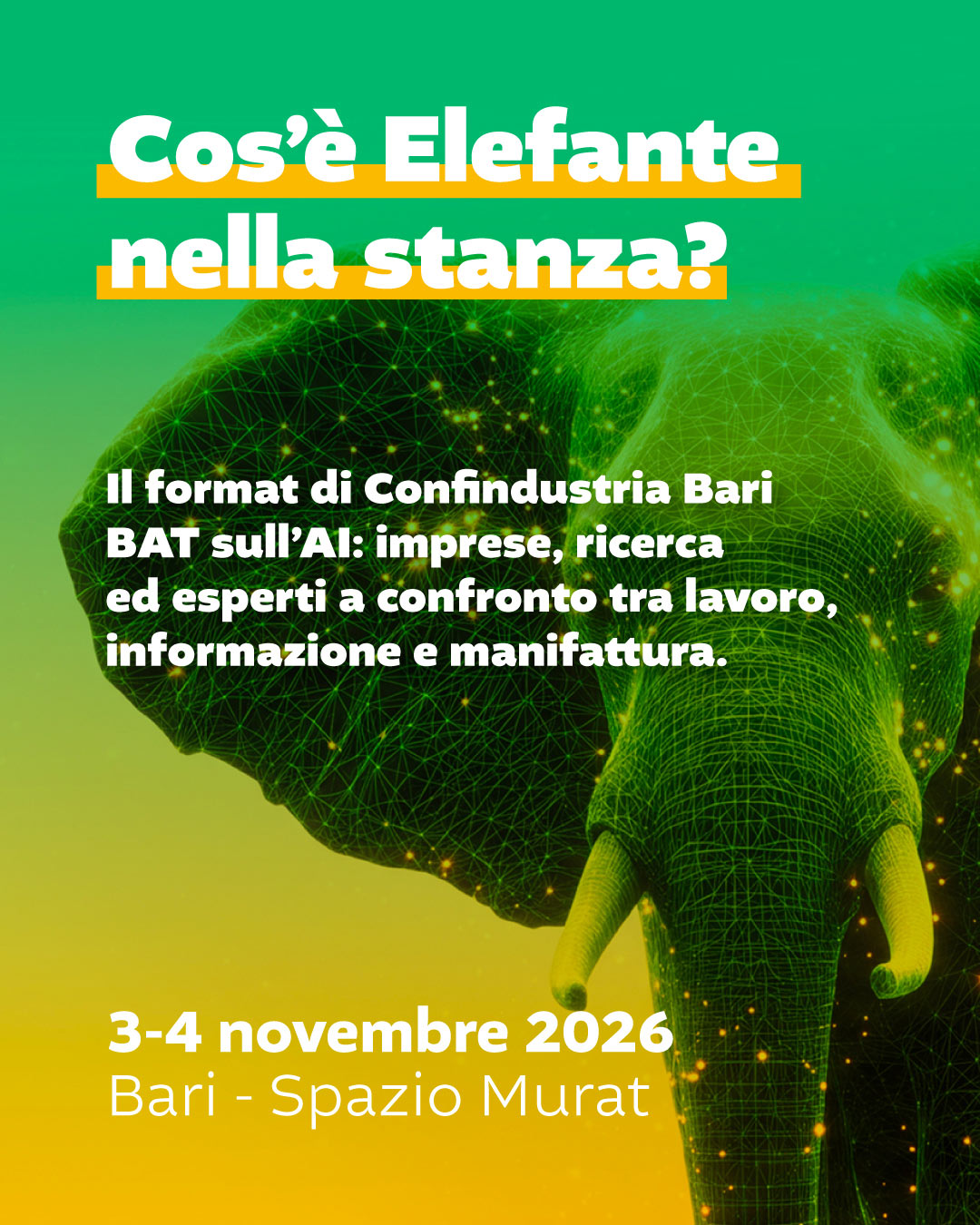
On November 3 and 4, 2026 , L'Elefante nella Stanza (The Elephant in the Room ) returns to Bari, the event organized by Confindustria Bari and BAT in collaboration with Intelligenza Artificiale spiegata Semplice ( Artificial Intelligence Explained Simple ), dedicated to the impact of artificial intelligence on work and business. Two days of talks, workshops , and case studies will explore how to transform AI's opportunities into concrete value.
Among the event's partners will be Jamio openwork , which will bring its experience developing digital solutions and Private AI projects integrated into Jamio services. This contribution will take shape with a talk by Salvatore Latronico, CEO of Openwork , who will lead the workshop "Sovereignty in the Age of Agentic AI" on November 3rd .
An opportunity to delve into an increasingly central issue for businesses: how to govern the evolution of artificial intelligence and exploit its potential while maintaining control over data, technologies, and processes.
Jamio openwork 's participation in the Confindustria event is part of the platform's evolution and innovation journey, with the aim of exploring concrete approaches to integrating artificial intelligence into business processes. This commitment places technological sovereignty, responsible innovation, and the ability to generate tangible value for organizations at its core.